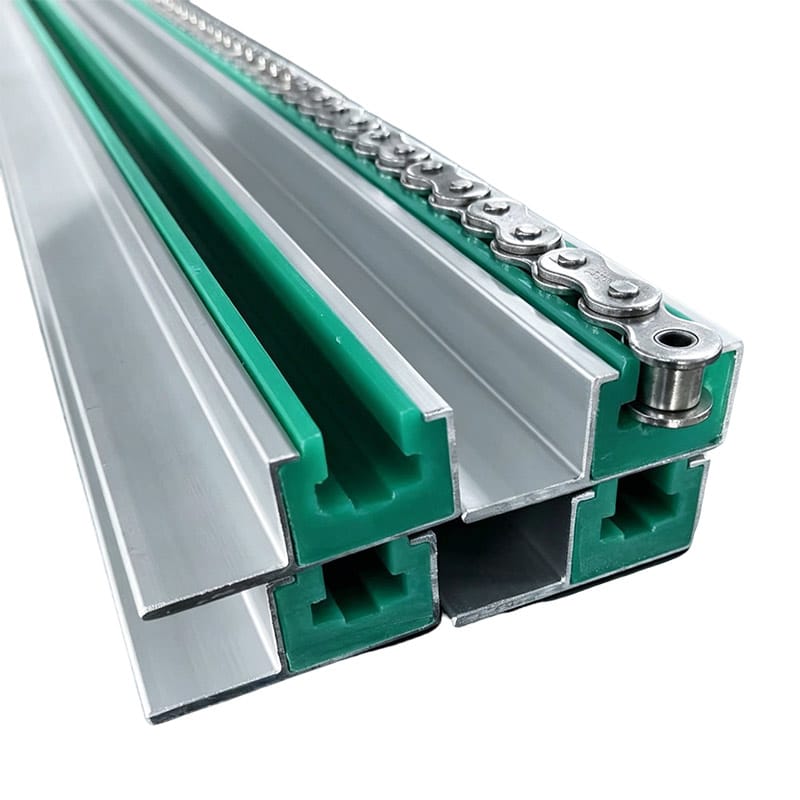
Uneven wear on a conveyor chain guide is often treated as a material problem.
A maintenance team removes the worn guide, installs another one made from UHMWPE, and expects the problem to disappear.
Then the same wear pattern returns.
One side of the guide becomes polished much faster than the other. A groove deepens in one section while adjacent areas still look almost new. The guide near a sprocket wears rapidly, while the middle of the conveyor remains relatively unaffected.
In many cases, the guide material is only part of the story.
Chain guide uneven wear often points to a mechanical condition somewhere in the conveyor system: misalignment, excessive chain tension, incorrect guide profile, insufficient support, contamination, damaged chain components, localized loading or thermal movement.
The wear pattern itself can therefore become a useful diagnostic tool.
For maintenance teams, conveyor manufacturers and equipment buyers, the goal should not simply be to replace a worn guide. It should be to determine why the guide wore in that particular location and direction.
This guide explains the most common causes of uneven conveyor chain-guide wear and the information that should be collected before ordering replacement UHMWPE chain guides.
Why Do Conveyor Chain Guides Wear Unevenly?
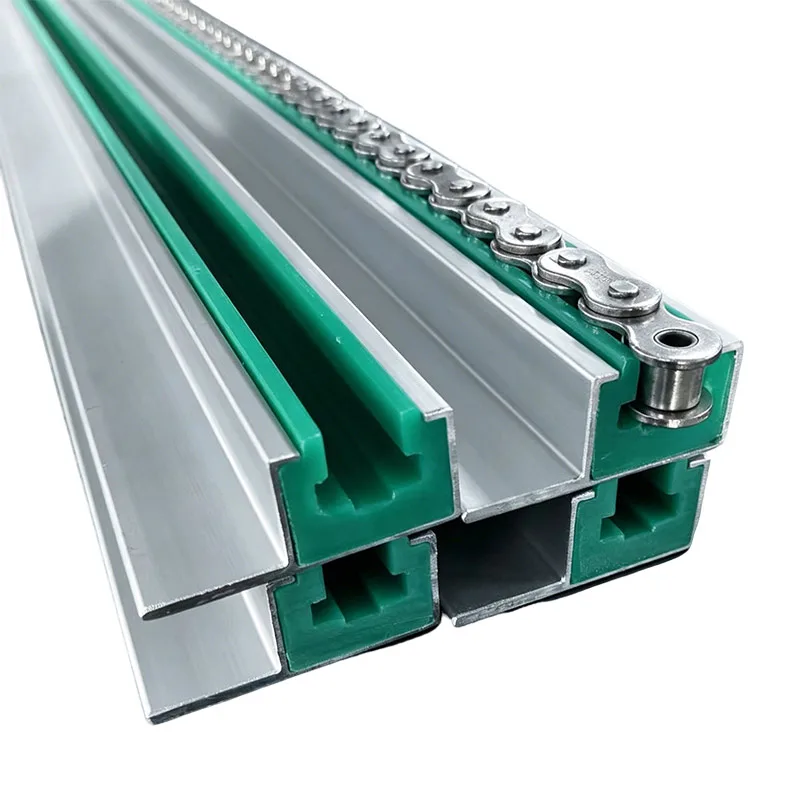
A chain guide should ideally maintain reasonably consistent contact with the moving chain along its intended running path.
In real conveyor systems, that contact is rarely perfectly uniform.
Wear becomes uneven when one area of the guide experiences more:
- Contact pressure
- Sliding distance
- Impact
- Heat
- Abrasive contamination
- Chain side force
- Mechanical movement
than another area.
The main question is therefore not:
“Why is UHMWPE wearing?”
All wear components eventually wear.
The better question is:
“Why is this part of the guide experiencing more severe conditions than the rest?”
That change in perspective makes troubleshooting much more effective.
What Does the Wear Pattern Tell You?
Before replacing the guide, examine the worn surface carefully.
Different patterns can suggest different causes.
One-Sided Wear
If one side of the chain guide is significantly more worn than the other, investigate:
- Chain alignment
- Sprocket alignment
- Side loading
- Conveyor frame distortion
- Incorrect guide position
The chain may be running continuously against one wall of the guide instead of remaining centered.
Localized Deep Grooves
A deep groove in one short area may indicate:
- A damaged chain link
- A protruding pin
- A misaligned sprocket
- A tight transition
- Local contamination
- A guide profile mismatch
The location of the groove can often help identify the source.
Heavy Wear Near the Drive Sprocket
If wear is concentrated near the drive end, possible causes include:
- Chain entry misalignment
- Excessive tension
- Incorrect sprocket position
- Inadequate transition geometry
- High local pressure
Heavy Wear Near the Return Section
The return side can have different tension and support conditions from the loaded side.
Uneven return-guide wear may be related to:
- Chain sag
- Poor support spacing
- Debris accumulation
- Incorrect guide height
Intermittent Polished Areas
Repeated polished patches can indicate that the chain is contacting the guide only at certain support points.
This may suggest:
- Guide deflection
- Uneven mounting
- Poor support spacing
- Conveyor frame irregularity
The guide surface is therefore valuable evidence. Do not discard the old component before documenting it.
How Misalignment Causes Chain Guide Uneven Wear
Alignment is one of the first things to check when a conveyor chain guide wears predominantly on one side.
A chain naturally follows the mechanical path created by:
- Drive sprocket
- Idler sprocket
- Shafts
- Guide rail
- Conveyor frame
If these elements do not share the intended centerline, the chain can be forced laterally.
The UHMWPE guide then becomes responsible for correcting the chain path continuously.
That creates increased side pressure and localized wear.
Check Sprocket Alignment
Two sprockets that appear visually aligned may still be offset enough to influence chain tracking.
Check:
- Shaft parallelism
- Sprocket axial position
- Sprocket centerline
- Sprocket runout
- Mounting condition
A new guide should not be used to compensate for an incorrectly positioned sprocket.
Check the Conveyor Frame
Frame distortion can also shift the guide away from the intended chain path.
Potential causes include:
- Welding distortion
- Impact damage
- Loose brackets
- Settlement
- Improper installation
- Previous modifications
Measure the guide position relative to stable mechanical references rather than relying only on visual inspection.
Check Guide Mounting Position
The guide itself may have been installed off-center.
This is especially possible when:
- Mounting holes are oversized
- Slotted holes allow adjustment
- Replacement rails were manually positioned
- Multiple short guide sections are installed independently
A few millimeters of offset repeated across several sections can create a visibly uneven wear pattern.
Why Excessive Chain Tension Accelerates Guide Wear
A chain that is too tight can increase contact force between the chain and the guide.
Higher contact force generally increases friction and can accelerate wear.
Excessive tension may also increase:
- Bearing loads
- Sprocket loads
- Heat generation
- Energy consumption
If a newly installed UHMWPE guide begins wearing much faster than expected, chain tension should be included in the inspection.
Signs That Tension May Be Too High
Possible indicators include:
- Rapid polishing of the guide
- Increased operating temperature
- High drive load
- Unusual chain noise
- Increased sprocket wear
- Reduced chain freedom
However, do not diagnose chain tension from guide appearance alone.
Compare the system against the chain and conveyor manufacturer’s adjustment requirements.
Too Little Tension Can Also Create Problems
A very loose chain can create:
- Excessive sag
- Impact
- Intermittent contact
- Chain jumping
- Unstable tracking
This can produce a different type of localized guide damage.
The target is not “as loose as possible” or “as tight as possible.”
The chain should operate within the manufacturer’s recommended tension or sag conditions.
How Chain Condition Affects UHMWPE Guide Life
A worn guide may actually be revealing a worn chain.
Chains change over time through:
- Pin wear
- Bushing wear
- Roller wear
- Link damage
- Elongation
- Corrosion
- Contamination
If the chain geometry changes, the way it contacts the guide can also change.
Inspect Chain Elongation
As pins and bushings wear, the effective chain pitch can increase.
This is often referred to as chain elongation.
An excessively worn chain may:
- Engage sprockets poorly
- Produce vibration
- Move differently through guide profiles
- Increase contact stress
Replacing only the guide while retaining a severely worn chain can result in rapid repeat wear.
Check for Damaged Links
A bent link or protruding component may create a narrow wear groove.
Inspect the entire chain for:
- Bent plates
- Damaged rollers
- Loose pins
- Corrosion
- Sharp edges
- Foreign objects trapped in the chain
A small chain defect can repeatedly pass over the same guide path thousands of times.
Why Contamination Can Create Severe Local Wear
UHMWPE is commonly selected for conveyor guides because of its low-friction and wear characteristics.
However, the interface between the chain and guide is rarely perfectly clean.
Contamination can enter from:
- Production debris
- Dust
- Sand
- Metal particles
- Product fragments
- Packaging debris
- Outdoor exposure
When hard particles become trapped between the chain and UHMWPE guide, the contact changes from relatively clean sliding to abrasive three-body wear.
What Is Three-Body Abrasion?
In simple terms, three-body abrasion occurs when loose particles are present between two moving surfaces.
In a conveyor system, the three elements may be:
- Chain
- UHMWPE guide
- Hard contaminant
Those particles can scratch or cut the guide surface as the chain moves.
The result may look like:
- Long scratches
- Scored channels
- Roughened surfaces
- Accelerated thinning
If this pattern appears, changing to a different guide grade without controlling contamination may not solve the problem.
Check Where Contamination Enters the Conveyor
Look at:
- Material transfer points
- Floor-level conveyors
- Outdoor sections
- Product spillage areas
- Lubrication points
- Nearby grinding or machining operations
Sometimes the best guide-life improvement comes from adding a simple shield, cleaning routine or debris removal point.
How Load Distribution Changes Chain Guide Wear
The chain does not necessarily carry the same load through every part of the conveyor.
Products may be:
- Loaded at one point
- Accumulated in one section
- Removed before another section
- Concentrated unevenly across the conveyor
This changes chain loading.
A heavily loaded section can create higher contact pressure between the chain and guide.
Accumulation Conveyors Need Special Attention
When products accumulate, the conveyor may continue running while the conveyed items remain stationary or partially restrained.
Depending on the conveyor design, this can increase friction and loading in certain regions.
Inspect whether uneven guide wear corresponds with:
- Accumulation zones
- Transfer points
- Inclines
- Curves
- Product loading stations
Wear location should always be compared with the actual process layout.
Why Curved Chain Guides Often Wear Differently
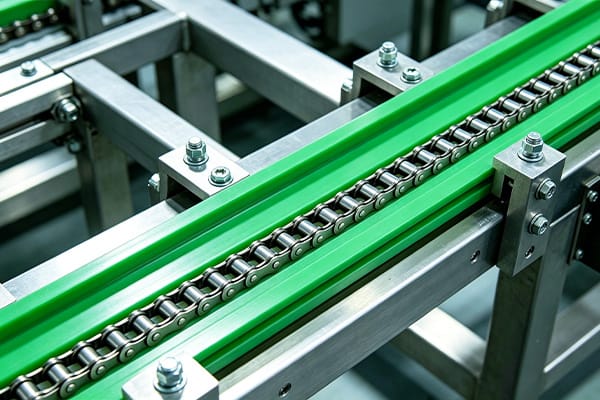
Curved chain paths naturally create additional lateral force.
When a chain follows a curve, it presses against the guiding surface differently from a chain traveling along a straight line.
This means curved UHMWPE chain guides may experience higher side contact.
Important design inputs include:
- Curve radius
- Chain type
- Chain speed
- Load
- Guide profile
- Lubrication
- Temperature
If the curve radius is too tight for the chain and operating conditions, changing the material alone may provide limited benefit.
Check the Entry and Exit of Curves
Wear is often concentrated where the chain enters or exits a curved section.
Inspect for:
- Abrupt transitions
- Misaligned straight and curved guides
- Sharp profile changes
- Poor support
- Incorrect chain centerline
Transitions should guide the chain smoothly rather than forcing it into an immediate change of direction.
How Guide Profile Affects Wear Distribution
A chain guide profile should match the chain geometry and the intended contact surfaces.
If the profile is incorrect, load may be concentrated over a small area rather than distributed as intended.
A Profile That Is Too Tight
If the guide clearance is too small, possible results include:
- Excessive friction
- Heat
- Binding
- Rapid wear
- Increased drive load
A Profile That Is Too Loose
Too much clearance may allow:
- Chain movement
- Impact
- Poor tracking
- Noise
- Localized contact
The correct profile should consider both the chain dimensions and operating clearance.
This is especially important when replacing a heavily worn guide using the old part as the only dimensional reference.
Why You Should Not Copy the Worn Surface Exactly
A common maintenance approach is to remove a worn UHMWPE guide, measure it and ask a supplier to reproduce the same profile.
This can create a problem.
The worn surface no longer represents the original geometry.
If the supplier copies the worn dimensions exactly, the replacement may include:
- Excessive clearance
- Incorrect chain centerline
- Distorted contact surfaces
- Uneven profile depth
A better reverse-engineering process uses:
- Chain dimensions
- Original mounting references
- Unworn guide surfaces
- Machine centerlines
- Existing drawings where available
The objective is to reconstruct the intended geometry, not reproduce the damage.
How Support Spacing Causes Local Wear
A long UHMWPE guide rail usually relies on a metal support structure.
If supports are too far apart, the guide can deflect between mounting points.
This may create changing contact pressure along the rail.
The chain can repeatedly contact the guide more heavily near:
- Brackets
- Fasteners
- Unsupported spans
The result may appear as periodic wear.
Look for Repeating Wear Intervals
If the worn pattern repeats at roughly the same spacing as the mounting brackets, investigate:
- Support distance
- Guide thickness
- Rail stiffness
- Fastener condition
- Frame flatness
The wear pattern may be telling you that the rail is moving under load.
Why Loose Fasteners Matter
A guide that is not firmly mounted can move as the chain passes.
This movement can cause:
- Vibration
- Enlarged holes
- Local wear
- Misalignment
- Noise
Inspect all mounting hardware when replacing guide rails.
Simply installing a new UHMWPE profile onto loose or damaged hardware may reproduce the problem.
Thermal Expansion Can Shift Long UHMWPE Guides
UHMWPE and steel do not expand by the same amount when temperature changes.
For long conveyor guides, this difference can become important.
If the plastic guide is rigidly locked along its entire length, temperature changes can contribute to:
- Buckling
- Bowing
- Joint movement
- Local misalignment
- Increased chain contact
The mounting arrangement should allow appropriate thermal movement according to the actual material properties and temperature range.
Look for Wear Near Joints
Long conveyors often use multiple guide sections.
At joints, inspect for:
- Steps between sections
- Closed expansion gaps
- Overlapping edges
- Misaligned profiles
- Raised ends
Even a small step can become a repeated impact point for the moving chain.
Why Heat Buildup Can Accelerate Wear
Friction produces heat.
If chain-guide contact pressure, speed or friction becomes excessive, local temperature can rise.
Higher temperature can affect the behavior of the plastic and may contribute to faster wear or dimensional change.
Possible causes of heat buildup include:
- Excessive chain tension
- Incorrect clearance
- High speed
- Poor alignment
- Contamination
- Insufficient lubrication where lubrication is part of the system design
If the guide feels unusually hot during operation, temperature measurement can provide useful diagnostic information.
Should You Lubricate UHMWPE Chain Guides?
There is no universal answer.
Some conveyor systems are designed to run dry, while others use lubrication according to the chain or equipment manufacturer’s requirements.
Do not introduce lubricant only because the guide is wearing.
Lubrication can affect:
- Product cleanliness
- Dust accumulation
- Food or packaging requirements
- Chain condition
- Friction
Follow the relevant equipment and chain manufacturer’s guidance.
UHMWPE is often selected specifically for low-friction sliding applications, but the complete chain system still needs correct maintenance.
How Conveyor Speed Influences Wear
Wear mechanisms often change as speed increases.
Higher speed means more sliding distance over the same operating time.
It may also increase:
- Heat generation
- Vibration sensitivity
- Dynamic loading
When discussing abnormal chain guide wear with a supplier, always provide conveyor speed if known.
A useful RFQ or troubleshooting inquiry should include:
- Linear chain speed
- Operating hours per day
- Number of shifts
- Start-stop frequency
Two identical guide profiles can have very different service lives in slow and high-speed conveyors.
Why Start-Stop Operation Matters
A conveyor that operates continuously may create different wear from a conveyor that starts and stops frequently.
Repeated acceleration can introduce:
- Dynamic chain loads
- Tension fluctuations
- Vibration
- Local movement
If wear is concentrated near certain drive or transition areas, operating sequence should be included in the investigation.
Is the UHMWPE Grade Always the Problem?
No.
Material grade is important, but it should be evaluated after checking the mechanical system.
If two guides made from the same material show drastically different wear on two otherwise similar lines, ask what is different about:
- Alignment
- Load
- Speed
- Chain condition
- Support
- Contamination
- Temperature
before concluding that the material is inconsistent.
When Material Grade Should Be Investigated
Material becomes a stronger suspect when:
- Several correctly aligned machines show similar unusually rapid wear
- Material documentation is unavailable
- Different batches behave differently
- The supplied grade differs from the specification
- The application exceeds the grade’s intended temperature or operating conditions
In those situations, request:
- Material identification
- Technical data
- Batch information
- Supplier records
Avoid making unsupported conclusions from color or appearance alone.
How to Troubleshoot Uneven Chain Guide Wear Step by Step

A structured process helps avoid replacing parts without identifying the cause.
Photograph the Wear Before Removing the Guide
Take photographs showing:
- Full conveyor section
- Guide position
- Wear direction
- Sprocket location
- Chain position
Do this before disassembly whenever safe and practical.
Mark the Orientation
Mark:
- Drive side
- Return side
- Left and right
- Chain direction
Once the guide is removed, orientation can otherwise become difficult to reconstruct.
Measure the Wear
Record:
- Original profile dimensions if known
- Remaining thickness
- Groove depth
- Wear width
- Distance from reference points
Do not rely only on descriptive terms such as “badly worn.”
Inspect the Chain
Check:
- Elongation
- Damaged links
- Rollers
- Pins
- Corrosion
- Sharp edges
Check Sprocket Alignment
Verify that sprockets and shafts match the intended chain path.
Check Guide Centerline
Measure guide position relative to stable machine references.
Check Supports and Fasteners
Look for:
- Loose bolts
- Bent brackets
- Excessive support spacing
- Damaged mounting holes
Inspect for Contamination
Identify debris that may be entering the chain-guide interface.
Record Operating Conditions
Include:
- Speed
- Load
- Temperature
- Hours
- Lubrication condition
Only after these checks should the replacement guide specification be finalized.
What Information Should You Send a Chain Guide Manufacturer?
A supplier can provide a much more meaningful recommendation when the inquiry includes actual system information.
For a custom UHMWPE chain guide, provide the following information.
Chain Information
Provide:
- Chain manufacturer
- Chain type
- Chain number
- Chain dimensions
- Drawing or specification
Guide Information
Provide:
- Cross-section drawing
- Total length
- Straight or curved
- Curve radius
- Mounting dimensions
- Hole or slot positions
- Required quantity
Operating Conditions
Provide:
- Chain speed
- Load
- Operating temperature
- Hours per day
- Lubrication condition
- Indoor or outdoor use
Failure Information
Provide:
- Current guide material
- Service life
- Wear photographs
- Wear location
- Remaining dimensions
- Noise or heat problems
Paowo Group also supplies other conveyor system components for industrial material-handling applications.
Common Mistakes When Replacing Worn Chain Guides
Several maintenance mistakes can cause repeat failures.
Replacing the Guide Without Inspecting the Chain
A damaged chain can rapidly wear a new guide.
Copying the Worn Profile
The worn geometry may not represent the original design.
Assuming All UHMWPE Is Identical
Material grade and manufacturing quality should match the application specification.
Tightening the Chain to Reduce Noise
Excessive tension may increase guide pressure and accelerate wear.
Ignoring Sprocket Alignment
The guide should not be used as a permanent correction for a misaligned drive system.
Ignoring Debris
Hard contaminants can substantially change the wear mechanism.
Installing Long Rails Without Considering Thermal Movement
Rigid mounting can contribute to bowing or misalignment.
Replacing One Guide Section Without Checking Adjacent Sections
A step between old and new profiles can create a new localized wear point.
Chain Guide Uneven Wear FAQ
Why Is My Conveyor Chain Guide Wearing on One Side Only?
One-sided wear commonly suggests chain or sprocket misalignment, guide positioning problems, side loading or frame distortion. Measure the chain centerline rather than replacing the guide immediately.
Why Does a New UHMWPE Chain Guide Wear Quickly?
Possible causes include excessive chain tension, damaged chain components, contamination, incorrect guide profile, alignment problems or a material grade that does not match the application.
Can a Worn Chain Damage a New UHMWPE Guide?
Yes. Chain elongation, damaged links, protruding components or worn rollers can change contact with the guide and accelerate wear.
Why Is the Chain Guide Hot?
Heat may result from excessive friction caused by tension, speed, poor alignment, tight clearance, contamination or other mechanical conditions.
Can I Copy an Old Worn Guide to Make a Replacement?
The old guide can be useful as a reference, but the worn surfaces should not automatically be copied. Chain dimensions, mounting references and unworn geometry should be used to reconstruct the intended profile.
Does a Thicker UHMWPE Guide Last Longer?
Not necessarily. A thicker guide provides more material, but uneven wear caused by misalignment or mechanical problems can continue. Correcting the cause is often more important than increasing thickness.
How Often Should Conveyor Chain Guides Be Inspected?
Inspection frequency depends on equipment criticality, operating hours, speed, load and historical wear rate. Establishing a regular wear measurement at the same reference points can make replacement planning more predictable.
Can UHMWPE Chain Guides Run Without Lubrication?
Many UHMWPE guide applications operate with low-friction sliding, but the chain manufacturer’s lubrication requirements and process conditions should determine the maintenance approach.
Conveyor Chain Guide Troubleshooting Checklist
Before ordering a replacement, collect the following information.
Wear Pattern
- One-sided or two-sided wear
- Groove depth
- Wear location
- Wear direction
- Photos
- Remaining thickness
Chain Condition
- Chain type
- Chain age
- Elongation
- Damaged links
- Roller condition
- Pin condition
Alignment
- Drive sprocket alignment
- Idler alignment
- Shaft alignment
- Guide centerline
- Frame condition
Operating Data
- Chain speed
- Load
- Operating hours
- Temperature
- Start-stop frequency
- Lubrication
Environment
- Dust
- Sand
- Product debris
- Metal contamination
- Outdoor exposure
- Cleaning procedures
Guide Specification
- Material
- Profile drawing
- Length
- Curve radius
- Mounting holes
- Support spacing
- Quantity
A complete set of information makes it easier to distinguish between a material issue and a conveyor-system issue.
Conclusion
Chain guide uneven wear should be treated as evidence, not simply as a signal to install another piece of plastic.
The location, direction and shape of the wear pattern can reveal problems involving:
- Chain alignment
- Sprocket position
- Excessive or insufficient tension
- Chain condition
- Contamination
- Load concentration
- Guide profile
- Support spacing
- Thermal expansion
- Conveyor speed
UHMWPE is widely used for chain guides and wear strips because its properties suit many sliding conveyor applications, but even a suitable material cannot permanently correct a mechanical problem elsewhere in the system.
Before replacing a guide, document the old wear pattern, inspect the chain, check alignment and collect actual operating conditions.
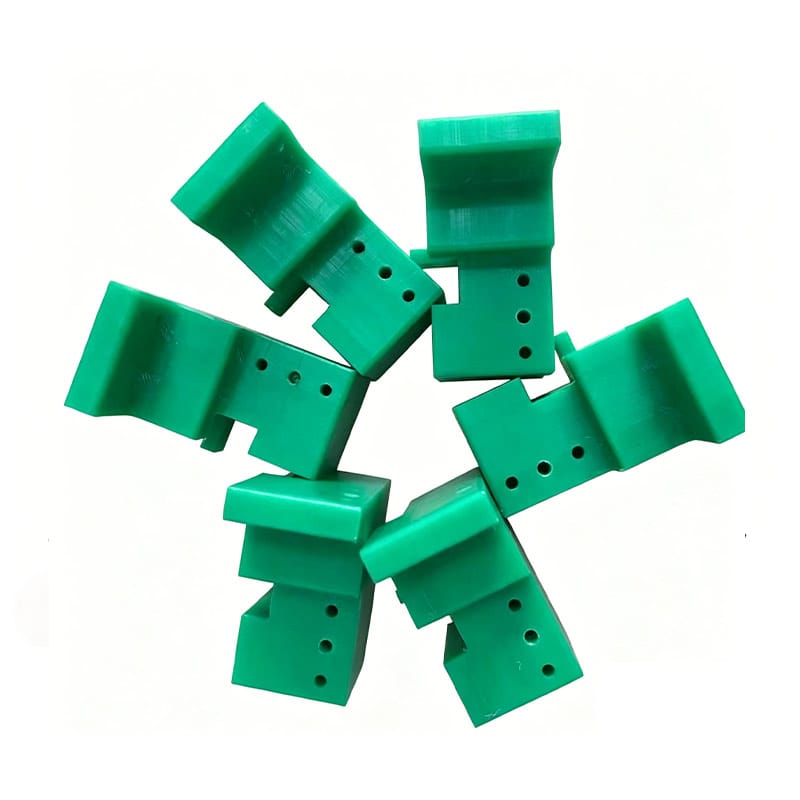
Paowo Group manufactures UHMWPE chain guides and custom guide profiles for industrial conveyor system components.
Send your chain model, profile drawing, guide length, conveyor speed, operating temperature, load information and photographs of the existing wear pattern for a replacement-guide review and quotation.