When buyers compare ground protection mats, most attention goes to the finished specification: length, width, thickness, surface pattern, connection holes and quoted load conditions.
But those specifications do not explain how consistently one mat will match the next.
For contractors, rental companies, utility crews and industrial buyers, understanding HDPE ground mat manufacturing provides another way to evaluate a supplier.
A reliable ground mat is not created simply by placing polyethylene into a mold and applying pressure. Material preparation, heating, compression, cooling, trimming, hole machining, surface inspection and dimensional checks all influence the finished product.
The manufacturing process becomes even more important when a project requires:
- Large quantities
- Repeat orders
- Mat-to-mat connection
- Consistent surface texture
- Controlled dimensions
- Customized colors
- Logos or identification
- Specific packaging
A professional HDPE ground mat manufacturing process should therefore focus on repeatability as much as individual mat appearance.
This guide explains how compression-molded HDPE temporary road mats can move from raw material to finished product, what buyers should expect manufacturers to inspect, and which records are worth requesting before approving a production batch.
What Is Compression-Molded HDPE Ground Mat Manufacturing?
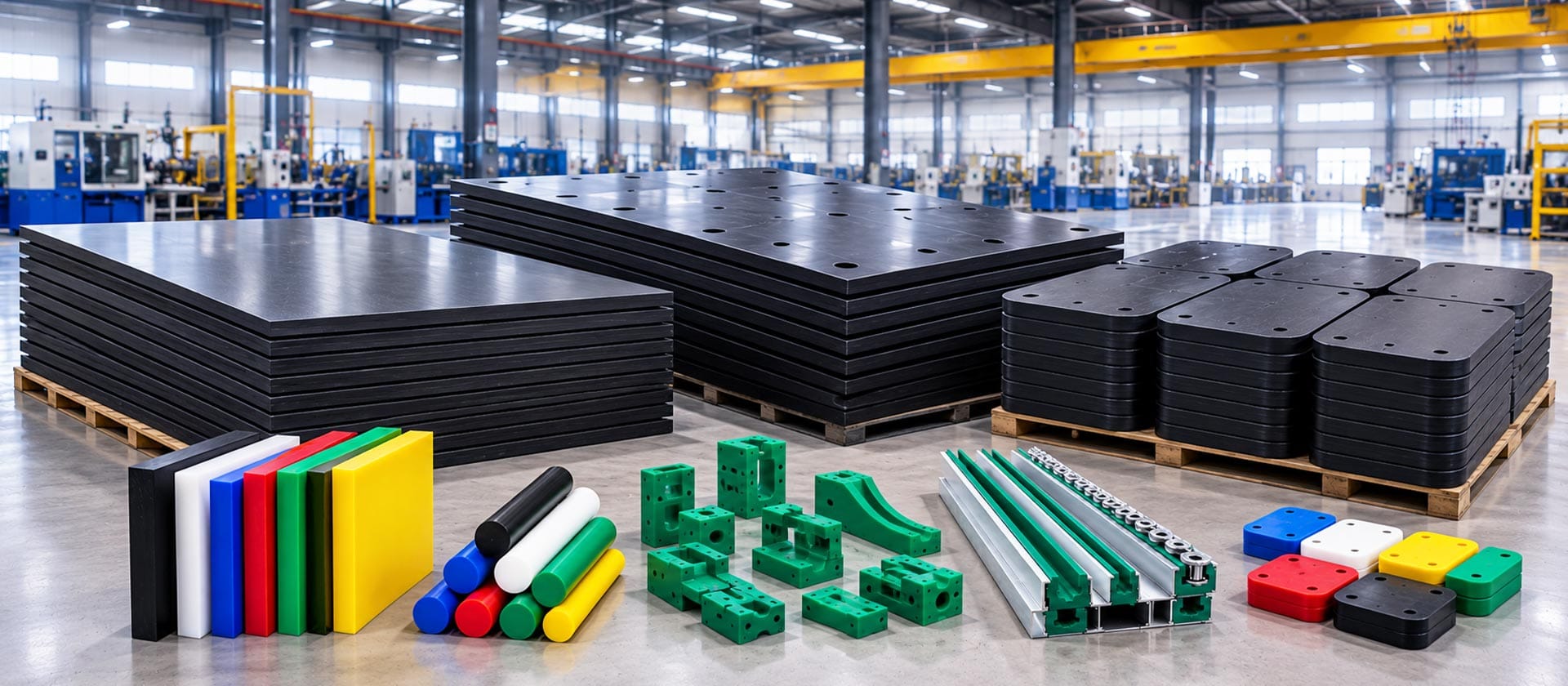
Compression molding is a process in which prepared polyethylene material is placed into a mold and formed under controlled heat and pressure.
For HDPE ground mat manufacturing, the mold determines much of the basic product geometry.
Depending on the product design, that can include:
- Mat length
- Mat width
- Nominal thickness
- Surface texture
- Edge geometry
- Logo features
After molding, the mat is cooled, removed from the mold and processed through additional finishing and inspection steps.
The exact production process varies by manufacturer and mat design.
Buyers should therefore treat this article as a manufacturing framework rather than assume every factory uses identical equipment, cycle times or process parameters.
Why Compression Molding Is Used for HDPE Ground Mats
Ground protection mats often have relatively large plan dimensions.
They may also require:
- Thick sections
- Textured surfaces
- Integrated patterns
- Reusable construction
Compression molding can be suited to this product format because the complete mat can be consolidated in a large mold.
For HDPE ground mat manufacturing, the method can also allow repeat production using a defined mold geometry.
That repeatability matters when multiple mats must:
- Align in a roadway
- Connect through matching holes
- Present similar surface texture
- Stack efficiently
The manufacturing method alone does not guarantee quality, however.
Process control and inspection are what determine whether those characteristics remain consistent from batch to batch.
Step One: Confirming the Ground Mat Specification
Good HDPE ground mat manufacturing begins before raw material enters the mold.
The manufacturer should first confirm the order specification.
Typical information includes:
- Mat length
- Mat width
- Thickness
- Surface pattern
- Color
- Connection holes
- Handle holes if applicable
- Logo
- Quantity
- Packaging
If the order is customized, drawings or approved samples may also be required.
This step is important because apparently small changes can influence production.
A different:
- Hole pattern
- Logo location
- Surface texture
- Color
may require different processing or finishing arrangements.
Step Two: Confirming the HDPE Material
The raw material should match the agreed specification.
Depending on the product, the manufacturer may need to control:
- Resin type
- Color
- Additive package
- Reprocessed content requirements
- UV-related requirements
Buyers should not assume that every black polyethylene ground mat contains the same formulation.
Color does not prove material identity.
A controlled HDPE ground mat manufacturing program should be able to identify what material is being used for the batch.
If material documentation is required for procurement, that requirement should be stated before production.
Step Three: Raw Material Preparation
Before molding, raw material needs to be prepared for the production process.
The objective is to create a consistent input for the mold.
Poor material preparation can make it harder to maintain:
- Surface consistency
- Color consistency
- Consolidation
- Finished geometry
Where color is customized, pigment distribution also needs appropriate control.
This is particularly important on large ground mats because color variation can become visually obvious across a broad surface.
For repeat HDPE ground mat manufacturing, consistency of material preparation supports consistency in the final product.
Step Four: Loading the Mold
The prepared material is placed into the molding system according to the manufacturer’s established process.
Uniform distribution matters.
If material is distributed unevenly before consolidation, the process may have to compensate for those differences during molding.
The mold itself should also be in suitable condition.
Checkpoints may include:
- Mold cleanliness
- Surface condition
- Texture condition
- Foreign material
A contaminated or damaged mold can transfer visible defects onto the finished mat.
Step Five: Heating and Compression
Heat and pressure are used to consolidate the polyethylene into the required shape.
This is one of the central stages of HDPE ground mat manufacturing.
The objective is not merely to soften the polymer.
The manufacturing cycle needs to produce a sufficiently consolidated mat with the intended geometry.
Important process variables can include:
- Temperature
- Pressure
- Heating time
- Material amount
- Mold condition
The exact values are manufacturing-specific.
Buyers generally do not need the factory’s proprietary process recipe, but a capable manufacturer should have controlled production parameters rather than relying on operator judgment alone.
Why Process Consistency Matters
Imagine ordering 500 ground protection mats.
A sample from the first batch looks good.
But if subsequent production uses inconsistent heating or cooling, buyers may see variation in:
- Dimensions
- Surface condition
- Flatness
- Weight
This is why HDPE ground mat manufacturing should be evaluated as a repeatable process, not simply through one attractive showroom sample.
Step Six: Forming the Surface Texture
Ground protection mats often use textured surfaces to improve interaction with tires, tracks or foot traffic.
The texture may include:
- Raised patterns
- Diamond-style patterns
- Traction features
- Molded surface geometry
In compression-molded HDPE ground mat manufacturing, much of this texture can be created directly by the mold.
That means mold condition affects texture quality.
Manufacturers should inspect for:
- Incomplete pattern
- Damaged pattern
- Surface defects
- Local deformation
Texture should be reasonably consistent across the mat and between pieces in the same order.
Surface Texture Is Not a Universal Traction Rating
A textured ground mat can improve grip compared with a smooth surface under suitable conditions.
However, traction still depends on:
- Mud
- Water
- Tires
- Tracks
- Slope
- Contamination
Therefore, HDPE ground mat manufacturing inspection can verify the physical texture, but it should not be converted into an unsupported universal anti-slip claim.
Actual site conditions still matter.
Step Seven: Controlled Cooling
Cooling is a critical part of plastic manufacturing.
A large molded mat changes temperature across a large physical area.
If cooling is poorly controlled, dimensional consistency can become more difficult.
Possible issues can include:
- Distortion
- Warping
- Uneven shape
For HDPE ground mat manufacturing, the goal is to cool the molded product in a controlled way before final finishing and inspection.
The manufacturer’s actual process may depend on:
- Mat size
- Thickness
- Mold design
- Production equipment
Buyers do not need to specify the cooling process unless it is part of an agreed manufacturing specification, but final dimensions should still be checked after the product has reached an appropriate inspection condition.
Why Large Mats Need Attention to Flatness
Ground mats are not precision machine plates.
They are large polymer products intended for outdoor use.
However, excessive distortion can still create practical issues.
For example:
- Mats may not stack properly
- Adjacent panels may not align
- Connections may become difficult
- Edges may lift unnecessarily
That is why flatness or general shape should be included in final HDPE ground mat manufacturing inspection.
The appropriate acceptance criteria should reflect actual mat function rather than unrealistic metal-style tolerances.
Step Eight: Removing the Mat from the Mold
Once the molding and cooling stage is complete, the product is removed.
At this point, the manufacturer can perform an initial visual assessment.
Typical checks may include:
- Overall shape
- Major surface defects
- Edge condition
- Texture
- Color
Clearly unacceptable pieces should be separated before additional processing.
This reduces wasted finishing work on products that would later be rejected.
Step Nine: Trimming and Edge Finishing
Compression-molded products may require trimming around edges or molding flash.
The finishing process should create a mat that can be:
- Handled safely
- Connected to adjacent mats
- Stacked
- Installed without unnecessary interference
Inspectors should look for:
- Excess flash
- Rough edges
- Incomplete trimming
- Damaged corners
Edge quality is particularly important where multiple panels meet.
Poorly finished edges can interfere with the temporary roadway layout.
Step Ten: Machining Connection Holes
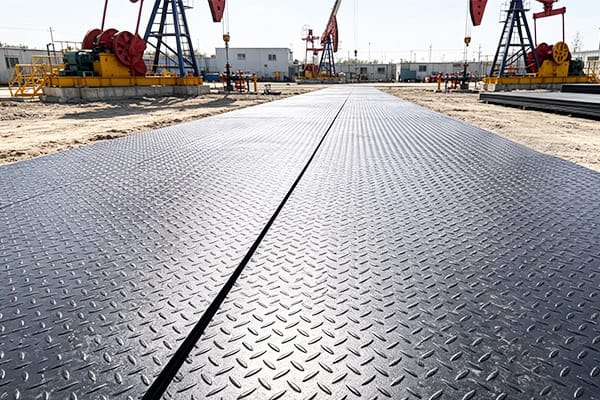
Many temporary road systems use connectors to keep adjacent mats aligned.
Connection holes may be:
- Molded
- Drilled
- Machined after molding
depending on design.
If holes are machined during HDPE ground mat manufacturing, their position should be controlled carefully.
Important dimensions include:
- Hole diameter
- Distance from edge
- Spacing
- Position relative to neighboring holes
If these dimensions vary excessively, mats from the same batch may become difficult to connect.
Why Hole Position Matters More Than It Looks
A single ground mat can tolerate small dimensional variation without obvious problems.
A temporary road made from dozens of mats is less forgiving.
A small alignment error repeated from panel to panel can create cumulative installation problems.
Therefore, connection-hole inspection is one of the more important functional checks in HDPE ground mat manufacturing.
For custom mat systems, the buyer should provide or approve the connection drawing before mass production.
Step Eleven: Handle and Lifting Feature Inspection
Some HDPE mats include:
- Hand holes
- Rope handles
- Other handling features
These features should be checked for:
- Correct position
- Clean machining
- Adequate edge condition
- Secure assembly where separate components are used
A poorly finished hand slot can make repeated handling less comfortable.
For large ground mats, handling features should also be designed with the actual finished mat weight in mind.
Step Twelve: Logo and Identification Inspection
Ground protection mats can be customized with:
- Company logos
- Product codes
- Asset numbers
- Other markings
For rental fleets, identification can be especially useful.
The HDPE ground mat manufacturing inspection should confirm that required markings are:
- Present
- Readable
- Correctly positioned
- Correct for the order
An incorrect logo may not affect engineering performance, but it still makes the finished product non-conforming to the commercial specification.
Step Thirteen: Dimensional Inspection
Dimensional inspection should verify the main product features.
Depending on the order, measurements may include:
- Length
- Width
- Thickness
- Hole diameter
- Hole spacing
- Edge distance
Not every dimension necessarily needs to be recorded for every single mat.
Inspection frequency may depend on:
- Batch size
- Manufacturing control plan
- Customer requirements
For larger orders, sampling inspection may be appropriate if agreed in advance.
Why Thickness Should Be Checked at Defined Locations
Large molded products may not be best represented by one random thickness measurement.
A more useful HDPE ground mat manufacturing inspection can use defined measuring points.
For example:
- Corners
- Midpoints
- Center region
The actual inspection method should match the mat design.
This gives better visibility into whether the product is reasonably consistent across its area.
Step Fourteen: Weight Inspection
Finished mat weight can provide another useful production-control indicator.
Weight depends on:
- Mat dimensions
- Material
- Product design
A major unexplained difference between nominally identical mats could indicate that the batch deserves further review.
Weight should not be treated as a substitute for dimensional inspection, but it can complement other HDPE ground mat manufacturing checks.
Buyers should ask for actual finished product weight if logistics or manual handling are important.
Step Fifteen: Visual Inspection
Visual inspection remains important even when dimensional measurements are acceptable.
Typical checks include:
- Surface defects
- Cracks
- Severe voids
- Edge damage
- Color consistency
- Texture completeness
- Markings
The goal is to identify defects that could affect:
- Handling
- Installation
- Appearance
- Function
For export orders, visual inspection before packing is particularly useful because correcting defects after international delivery is much more difficult.
Step Sixteen: Connection Trial
For ground mat systems using connectors, a trial assembly can provide strong practical evidence.
A manufacturer can select multiple mats and confirm that:
- Holes align
- Connectors fit
- Edges meet appropriately
This is especially valuable:
- For a new mold
- After a design change
- For a new connector configuration
- Before a large first production order
A connection trial verifies something that individual dimensions alone may not fully show: whether the finished pieces work together as a system.
Step Seventeen: Sampling and Batch Inspection
Large HDPE ground mat manufacturing orders may use a defined sampling plan rather than measuring every characteristic of every product.
The actual inspection level should depend on:
- Order size
- Customer requirement
- Product risk
- Production history
Typical batch checks may include:
- Dimensions
- Appearance
- Holes
- Weight
- Surface pattern
If the buyer needs a specific inspection standard or report, that should be stated during RFQ rather than requested after the goods are already packed.
What Should a Ground Mat Inspection Report Include?
Depending on the project, an inspection report may record:
- Product model
- Batch
- Quantity inspected
- Length
- Width
- Thickness
- Hole position
- Weight
- Visual inspection result
Photos may also be included.
A useful HDPE ground mat manufacturing report should correspond to the actual specification being purchased.
There is little value in a long report containing measurements that do not affect the product’s function while ignoring critical connector positions.
Why First Article Approval Can Be Useful
For a new customized ground mat, first article approval can reduce risk before full production.
The first article can confirm:
- Dimensions
- Color
- Surface pattern
- Logo
- Connection holes
- Handle features
Buyers can review the sample or inspection record before the full order is released.
For customized HDPE ground mat manufacturing, this is especially useful when a new:
- Mold
- Logo
- Hole layout
- Surface configuration
is involved.
What a First Article Does Not Prove
A good first article does not prove that every future mat will automatically match.
Mass production still needs process and inspection control.
The first article establishes the approved configuration.
Batch inspection then helps confirm that production continues to follow it.
Step Eighteen: Cleaning Before Packing
Finished mats may accumulate:
- Plastic chips
- Dust
- Trimming debris
- Manufacturing residue
These should be removed before packing.
A clean product is easier to inspect and more professional to receive.
Cleaning also makes it easier to see whether:
- Logos
- Surface patterns
- Holes
are in acceptable condition.
Step Nineteen: Packaging and Stacking
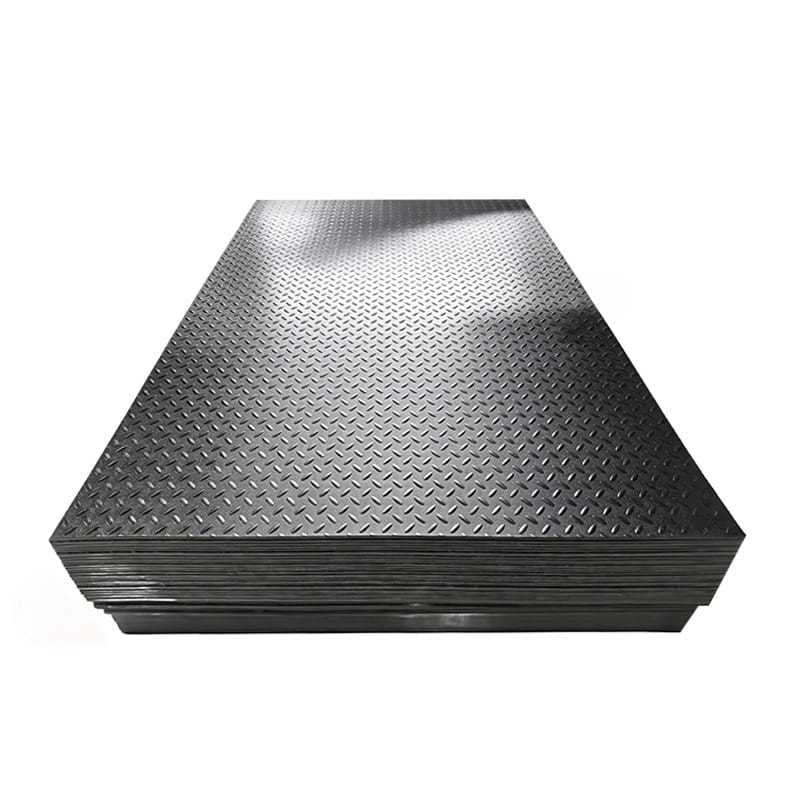
Ground mats are relatively large products.
Packaging should keep them organized during:
- Warehouse handling
- Container loading
- Transportation
- Customer unloading
Depending on dimensions and quantity, packing may use:
- Pallets
- Bundles
- Straps
- Protective wrapping
The packaging method should avoid creating unnecessary distortion or damage.
For large international orders, packaging should also match the unloading method available at the destination.
Why Packaging Is Part of Manufacturing Quality
A product can pass every factory inspection and still arrive damaged if packing is unsuitable.
Therefore, HDPE ground mat manufacturing quality control should extend through final packing.
Check:
- Stack stability
- Strap position
- Label accuracy
- Quantity per package
For multiple customized models, labels should clearly separate each item.
What Manufacturing Evidence Should Buyers Request?
A buyer does not necessarily need hundreds of factory photographs.
More useful evidence may include:
- Raw material identification
- Production photos
- Finished mat photos
- Dimensional inspection records
- Connection trial photos
- Packaging photos
For customized orders, a photo showing the actual:
- Color
- Logo
- Hole arrangement
can help confirm that the batch matches the order before shipping.
Avoid Unverified Universal Load Claims
Manufacturing quality and load suitability are related but not identical.
A well-manufactured ground mat still needs to be selected for the actual site.
A statement such as:
“this mat supports 100 tons”
is incomplete without explaining conditions such as:
- Ground support
- Contact area
- Vehicle configuration
- Test setup
Professional HDPE ground mat manufacturing documentation should separate verified product specifications from application-dependent load recommendations.
How Buyers Can Audit an HDPE Ground Mat Manufacturer
Supplier evaluation should focus on the manufacturer’s ability to control the process repeatedly, not only on whether one sample looks good.
A useful audit asks whether the supplier can explain how the mat is made, what is inspected, which characteristics are recorded and how a custom specification is kept consistent across a batch.
For HDPE ground mat manufacturing, buyers should pay particular attention to material control, dimensions, connection-hole accuracy, surface condition and inspection evidence.
Ask What Material Is Actually Being Used
The supplier should be able to identify the material being quoted.
Useful questions include:
- What HDPE formulation is used?
- Is the material specification controlled?
- Are color and additive requirements documented?
- Can relevant material documentation be provided if required?
Do not rely only on product color or appearance as proof of material identity.
If your project has a specific requirement for virgin content, recycled content, UV-related properties or another formulation detail, include it in the RFQ.
Ask How the Mats Are Formed
The supplier should be able to explain whether the product is compression molded or produced through another defined manufacturing route.
For compression-molded HDPE ground mat manufacturing, buyers can ask how the factory controls:
- Mold preparation
- Material loading
- Heating
- Compression
- Cooling
- Demolding
You do not need the manufacturer’s proprietary processing recipe.
The goal is to confirm that the factory follows a repeatable production process rather than relying entirely on operator judgment.
Ask How Dimensions Are Inspected
Confirm which finished dimensions are routinely checked.
These may include:
- Length
- Width
- Thickness
- Hole diameter
- Hole spacing
- Edge distance
If your temporary road depends on mats connecting accurately, hole position can be more important than a cosmetic dimension.
Inspection should follow the functional requirements of the product.
Ask Where Thickness Is Measured
One thickness measurement may not represent a large mat adequately.
Ask whether the supplier uses defined measurement locations, such as:
- Corners
- Edge midpoints
- Center area
For custom orders, buyer and supplier can agree on the measurement approach before production.
This reduces disagreement later about whether a mat meets the specified thickness requirement.
Ask How Connection Holes Are Controlled
This is particularly important for multi-panel temporary road systems.
A connection hole that is slightly misplaced may not appear serious on one isolated mat, but repeated positional differences can make a long temporary roadway difficult to assemble.
Ask the supplier:
- How are holes positioned?
- Are jigs or CNC processes used?
- What dimensional checks are performed?
- Can several finished mats be test-connected?
Connection accuracy is one of the most useful indicators of practical HDPE ground mat manufacturing quality.
Ask Whether a Connection Trial Can Be Performed
For new or customized mat systems, ask the supplier to connect several production pieces before shipment.
A trial assembly can confirm:
- Hole alignment
- Connector fit
- Edge relationship
- Basic system compatibility
This is especially useful after:
- A new mold
- A hole-layout change
- A new connector
- A customized mat dimension
A connection trial provides stronger practical evidence than inspecting only one isolated panel.
Ask to See Real Production and Inspection Evidence
Actual factory evidence is more useful than generic product photography.
Depending on your project, useful evidence can include:
- Raw material identification photos
- Molding-process photos
- Finished mat photos
- Dimensional inspection photos
- Connection-test photos
- Packaging photos
For custom orders, ask for images showing the actual:
- Color
- Logo
- Hole layout
- Surface pattern
before shipment.
This helps confirm that the batch being packed matches the approved order.
Ask Whether First Article Approval Is Available
First article approval is useful when the project includes a new or customized specification.
The first article may be used to confirm:
- Length
- Width
- Thickness
- Surface pattern
- Connection holes
- Logo
- Color
- Handling features
Once approved, it establishes the reference configuration for subsequent production.
A first article should not be treated as a substitute for batch quality control, but it can significantly reduce specification risk before mass production begins.
Ask What Batch Inspection Is Performed
For larger orders, confirm how the supplier checks continued production after the first article.
The inspection plan may include sampling for:
- Dimensions
- Thickness
- Hole position
- Weight
- Appearance
- Surface pattern
If you require a particular sampling level or inspection report format, define it during the quotation stage.
Do not wait until the mats are already manufactured and packed.
Ask How Non-Conforming Mats Are Controlled
A useful supplier audit should also consider what happens when a product does not meet the agreed specification.
Ask whether non-conforming pieces are:
- Segregated
- Identified
- Reworked where appropriate
- Rejected
- Prevented from being mixed into approved stock
This becomes more important on large orders where visually similar mats may be stored together.
Ask How Customized Versions Are Kept Separate
If your order includes more than one mat model, the supplier should have a clear way to distinguish them.
Differences may involve:
- Thickness
- Hole pattern
- Color
- Logo
- Surface texture
Packaging labels should identify the correct product.
Weak segregation can create receiving problems even when every individual mat is manufactured correctly.
What Documents Should Buyers Request?
Documentation requirements should match the project.
Not every order needs an extensive quality dossier, but commercial buyers may reasonably request selected evidence.
Product Specification
The agreed product specification should define:
- Mat size
- Thickness
- Color
- Surface pattern
- Connection arrangement
- Quantity
This should be the basic reference for production.
Material Information
If material documentation is required, specify exactly what you need.
Possible examples include:
- Technical data
- Material identification
- Supplier declaration
- Batch-related information where available
Avoid asking generically for “all certificates” when the project has no defined document requirement.
Dimensional Inspection Report
For customized mats, an inspection report may record:
- Length
- Width
- Thickness
- Connection-hole measurements
- Other agreed critical dimensions
The report should correspond to the characteristics that actually affect installation and use.
First Article Record
For a new customized product, a first article record can include:
- Measurements
- Product photos
- Logo photos
- Hole-layout confirmation
- Approval status
This creates a useful reference for repeat orders.
Packaging Photos
For export orders, packaging photos can help confirm:
- Quantity
- Stacking
- Labels
- Pallet or bundle condition
These are particularly useful when the product is large and difficult to repackage after delivery.
How to Compare Two HDPE Ground Mat Suppliers
When two quotations appear similar, compare more than unit price.
Compare the Actual Material Specification
Make sure both suppliers are quoting the same or clearly defined material requirement.
Do not assume that two products described simply as “HDPE ground mats” are technically identical.
Compare Finished Dimensions
Check:
- Length
- Width
- Thickness
- Tolerances
A lower-priced mat with materially different dimensions is not a direct comparison.
Compare Connection Design
If the mats will be joined into temporary roads, compare:
- Hole pattern
- Hole diameter
- Connector design
- Edge geometry
The system-level fit may be more important than a small price difference per mat.
Compare Surface Pattern
Different textures can affect:
- Installation orientation
- Cleaning
- Interaction with tires or tracks
Do not assume two textured mats have the same geometry.
Compare Inspection Scope
One supplier may include:
- First article inspection
- Batch measurements
- Packing photos
while another supplies only finished mats with no inspection record.
These are different commercial scopes.
Compare Customization
Confirm whether the quotation includes:
- Logo
- Color
- Connection holes
- Handles
- Identification
Additional processing should be included when comparing total price.
Compare Packaging
Check whether the packing method is appropriate for:
- Container loading
- Warehouse handling
- Customer unloading
Poor packing can erase savings achieved through a lower product price.
Why Factory Evidence Matters for Repeat Orders
A single successful order does not automatically create long-term consistency.
Repeat projects benefit from controlled references such as:
- Approved dimensions
- Drawing or specification
- First article
- Product code
- Inspection method
This makes it easier to reproduce the same configuration months later.
For buyers using mats across multiple projects or selling them through a rental fleet, repeatability is often more valuable than minor cosmetic differences.
A structured HDPE ground mat manufacturing system should make the approved product identifiable for future orders.
Common HDPE Ground Mat Manufacturing Quality Problems
Several issues deserve attention during production review.
Inconsistent Dimensions
Large variation in length, width or thickness can create:
- Stacking problems
- Uneven roadway joints
- Installation difficulty
The acceptable tolerance should be matched to the actual product function.
Misaligned Connection Holes
Poor hole positioning can make adjacent mats difficult or impossible to connect.
This is one of the most important defects for modular temporary access systems.
Incomplete Surface Pattern
A poorly formed texture may indicate inconsistent molding or mold-condition issues.
Inspect both:
- Overall texture
- Local incomplete areas
Excessive Edge Flash
Untrimmed flash can interfere with:
- Handling
- Stacking
- Mat-to-mat positioning
It can also make the finished product appear poorly controlled.
Excessive Distortion
A ground mat does not need precision-machine flatness, but excessive bow or twist may interfere with:
- Stacking
- Connections
- Temporary roadway layout
The acceptance criterion should be functional.
Incorrect Logo or Identification
This is a commercial non-conformance even if the mat remains physically usable.
Confirm artwork and location before mass production.
Mixed Colors or Product Versions
Weak batch segregation can result in:
- Incorrect shipment
- Mixed mat thicknesses
- Wrong hole patterns
Clear product identification and packaging control help prevent these errors.
Rough or Damaged Handling Features
Hand holes and other handling features should be clean enough for practical repeated use.
Inspect:
- Burrs
- Sharp edges
- Incorrect dimensions
- Local damage
What Buyers Should Not Expect from Factory Inspection
Manufacturing inspection can verify the product that leaves the factory.
It cannot by itself prove that the mat is suitable for every jobsite.
Factory inspection may confirm:
- Dimensions
- Material specification
- Surface texture
- Connection holes
- General appearance
It does not independently establish:
- Soil bearing capacity
- Vehicle suitability under every configuration
- Safe performance on every slope
- Performance over saturated ground
These are application questions.
This distinction is important when reviewing HDPE ground mat manufacturing claims.
Avoid Unverified Universal Load Claims
A statement such as:
“supports 100 tons”
is incomplete without test or engineering conditions.
Load suitability can depend on:
- Mat dimensions
- Thickness
- Vehicle contact area
- Ground support
- Load distribution
- Test method
A responsible manufacturer should be able to explain the basis of any published load claim.
If the claim is based on a test, ask for:
- Test configuration
- Support condition
- Load application
- Relevant mat dimensions
If those details are unavailable, do not treat the headline number as a universal site rating.
HDPE Ground Mat Manufacturing FAQ
How Are HDPE Ground Protection Mats Made?
Large ground protection mats can be produced by compression molding. The process generally includes material preparation, molding under heat and pressure, controlled cooling, trimming, finishing, inspection and packaging.
The exact production sequence depends on the manufacturer’s equipment and product design.
Why Is Cooling Important in HDPE Ground Mat Manufacturing?
Cooling affects the final condition of a large molded polymer part.
A controlled process helps the manufacturer manage:
- Shape
- Dimensions
- Distortion
Final inspection should take place under an appropriate stable condition rather than while the mat is still significantly affected by processing temperature.
Are Connection Holes Molded or Machined?
Either may be possible depending on mat design.
Some holes may be integrated into the molding process, while others may be drilled or machined afterward.
For the buyer, the critical issue is that finished hole size and position match the approved connection system.
How Is Ground Mat Thickness Inspected?
Thickness can be measured at defined locations across the mat.
For a large product, multiple points can provide a better picture of consistency than one random measurement.
The inspection method should be agreed when thickness tolerance is important.
Should Every Ground Mat Be Dimensionally Inspected?
Not necessarily.
Depending on production volume and quality requirements, a manufacturer may use:
- First article inspection
- In-process checks
- Sampling inspection
If your procurement system requires every piece to be inspected, state that before quotation because it affects labor and cost.
Can Ground Mats Be Customized with a Logo?
Yes, depending on product design and manufacturing capability.
Before production, confirm:
- Artwork
- Dimensions
- Position
- Orientation
A first article or production photo can help verify the result.
Can HDPE Ground Mats Be Made in Different Colors?
Yes, subject to material formulation and manufacturing requirements.
Custom colors may affect:
- Minimum quantity
- Production planning
- Material preparation
Color should be specified before production begins.
What Should I Inspect Before Accepting a Ground Mat Order?
Useful checks include:
- Length
- Width
- Thickness
- Connection-hole position
- Overall shape
- Surface pattern
- Color
- Custom markings
- Packaging
For new connection systems, a trial assembly of several mats is also valuable.
Does an Inspection Report Prove the Mat Can Support My Equipment?
No.
An inspection report verifies agreed product characteristics.
Equipment suitability also depends on:
- Vehicle or equipment loading
- Tire or track contact
- Ground strength
- Site conditions
- Traffic pattern
Those conditions require a separate application assessment.
Can Paowo Provide Customized HDPE Ground Mats?
Yes. Paowo Group supplies HDPE temporary road mats for temporary access and ground-protection applications, with customization options based on actual project requirements.
HDPE Ground Mat Manufacturing Inspection Checklist
Use the following checklist when reviewing a supplier or production order.
Raw Material
- Material specification confirmed
- Color requirement confirmed
- Additive requirements confirmed if applicable
- Required material documents available
Product Specification
- Length confirmed
- Width confirmed
- Thickness confirmed
- Quantity confirmed
- Product model confirmed
Molding Quality
- Overall shape acceptable
- Surface pattern complete
- No unacceptable major molding defects
- Color reasonably consistent
Edge Finishing
- Excess flash removed
- Corners acceptable
- Edges suitable for handling and installation
Connections
- Hole diameter checked
- Hole spacing checked
- Edge distance checked
- Connector fit verified
- Multi-mat trial performed where required
Handling Features
- Hand holes correctly positioned
- Rope handles or other features installed as specified
- Handling edges finished appropriately
Customization
- Logo correct
- Logo position correct
- Product marking correct
- Asset identification correct if required
Dimensional Inspection
- Length
- Width
- Thickness
- Other critical dimensions
- Sampling quantity recorded where applicable
Visual Inspection
- No unacceptable cracks
- No major surface defects
- No severe distortion
- No shipping damage before packing
Packaging
- Quantity per bundle or pallet correct
- Product labels correct
- Stacking stable
- Protection appropriate
- Packaging photos available if required
A checklist like this gives buyers a more practical way to evaluate HDPE ground mat manufacturing than relying only on catalog photos or generic factory claims.
Conclusion
Reliable HDPE ground mat manufacturing is not defined by one molding machine or one attractive sample.
It depends on the complete process, including:
- Material confirmation
- Mold preparation
- Heating and compression
- Controlled cooling
- Trimming
- Connection-hole control
- Surface inspection
- Dimensional inspection
- Batch sampling
- Packaging
For buyers, the most important question is whether the manufacturer can reproduce the approved specification consistently across the order.
That is especially important when dozens or hundreds of mats must connect together to create a temporary roadway.
A small dimensional or hole-position issue on one panel can become a larger installation problem when repeated across an entire system.
Manufacturing evidence and application suitability should also remain separate.
Factory inspection can confirm that a mat matches the agreed product specification. It cannot prove that the same mat is appropriate for every machine, soil condition, slope or traffic pattern.
Paowo Group manufactures HDPE temporary road mats for construction, utility, landscaping and temporary access applications, with customizable dimensions, surface patterns, connections, colors and identification features.
Request a Quote
For a new HDPE ground protection mat project, send Paowo Group your:
- Required mat length
- Width
- Thickness
- Quantity
- Surface-pattern requirement
- Connection-hole layout
- Connector requirements
- Color
- Logo or asset-marking requirements
- Vehicle or equipment information
- Ground conditions
- Required inspection documents
Paowo can review the specification and discuss the appropriate production, sample and inspection requirements before mass production.