Table of Contents
A sleeve has a large counterbore beside a thin wall. For buyers reviewing UHMWPE sleeves, the practical question is whether the offered product and its supporting evidence address this specific requirement.
This guide examines wall thickness around a stepped bore as a defined engineering and purchasing decision. It connects the duty, interface, qualification and quotation so procurement can resolve the important questions before releasing an order.

Wall Thickness Around a Stepped Bore
A locally thin section can distort under clamping or installed restraint.
Identify the thinnest wall beside each bore step and show how the sleeve is held during machining and installation. Compare roundness after release with the agreed inspection condition. If a thin section moves with clamp pressure, preserve that evidence. A tighter general bore tolerance does not resolve a geometry or restraint problem by itself.
Start by separating the observed symptom from the proposed product change. Record what happens, where it happens and the operating condition in which it matters. That makes the review of UHMWPE sleeves specific enough to support a decision, rather than a comparison of broad product descriptions.
Tolerance choices
Tolerances for UHMWPE sleeves should reflect function and an achievable inspection method. A tight blanket tolerance can raise machining cost while leaving the critical clearance undefined. Distinguish working interfaces from noncritical faces and explain any special requirement. Ask the fabricator to flag difficult features before release instead of treating all dimensions as equally important.
The inputs that define UHMWPE sleeves
Record bore steps, remaining wall, datum faces, assembly pressure. Keep the units, revision and source of each input with the inquiry. Distinguish a measured value from an estimate, and identify the person responsible for resolving any critical unknown. A supplier can review an explicit assumption; an undocumented assumption is much harder to detect.
Workholding effects
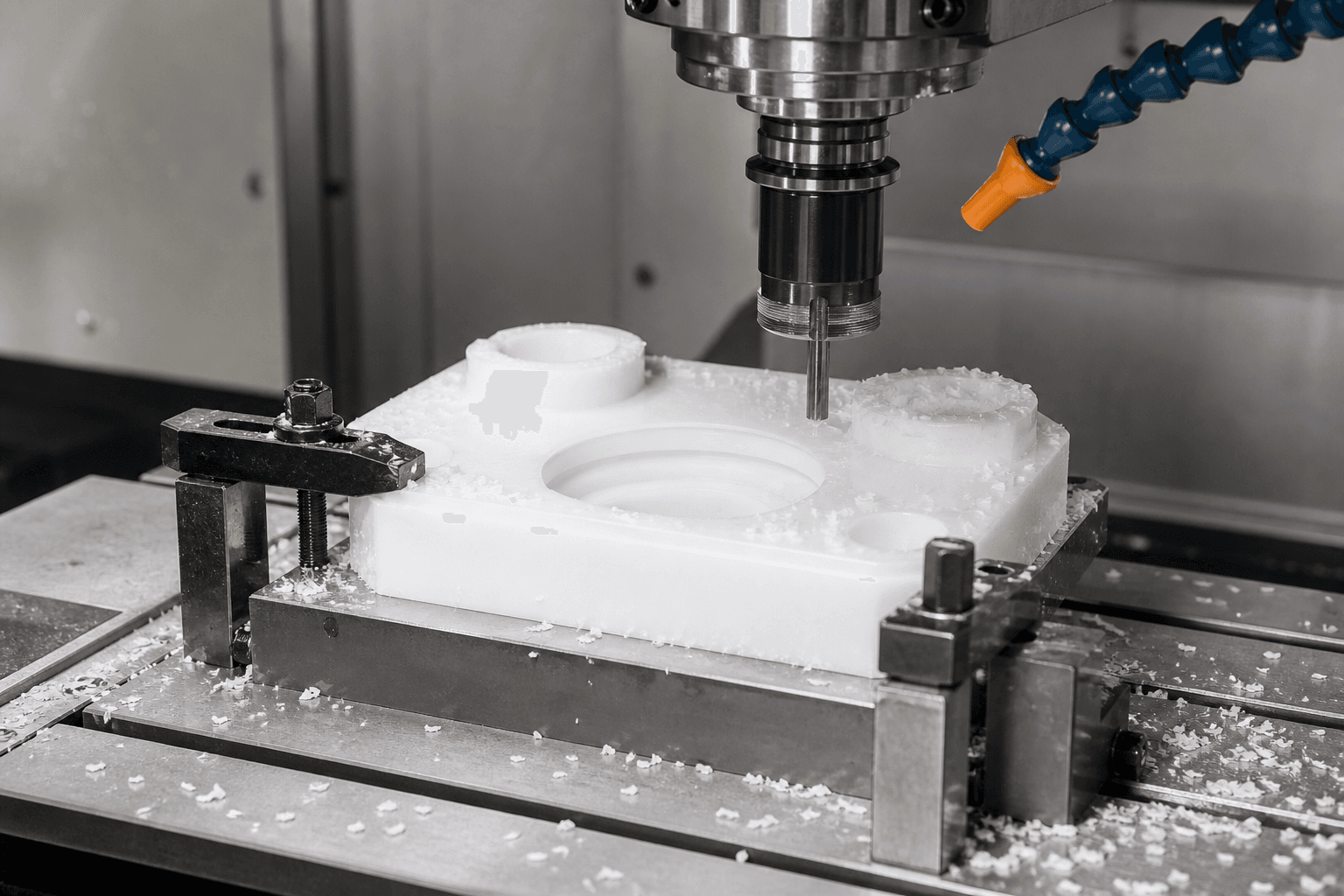
The machining fixture for UHMWPE sleeves can affect apparent dimensions while the part is restrained. Flexible walls and thin ribs may move under clamping and cutting forces. Specify acceptance after release unless the drawing deliberately defines another condition. A first article should expose this behavior before the same fixture is used for an entire batch.
Design the complete interface: UHMWPE sleeves
Identify critical sections and avoid assuming that one general tolerance covers all features.
Review UHMWPE sleeves in the installed arrangement. Show adjoining components, the direction of movement or load, and the space needed for installation and later removal. If the interface changes, update the released drawing and acceptance basis together so the quote and the technical approval still refer to the same requirement.
Fastening
Repeated assembly and clamp load can matter in UHMWPE sleeves. Review threads, inserts, through-fixings and the remaining section with the responsible designer. Include the mating hardware and assembly expectations in the specification. Do not assign a universal tightening value without a validated fastening design; inspection should verify the approved geometry and seating condition.
Compare the available procurement routes
Use the comparison below to decide what must happen before purchasing UHMWPE sleeves. The routes describe different scopes of work; they are not interchangeable offers. In this application, the controlling issue is wall thickness around a stepped bore. An apparently cheaper route may leave that issue unresolved.
| Route | When it merits review | Evidence needed before release |
|---|---|---|
| Approved drawing reproduction | Suitable when nominal geometry, grade and duty are established. | Control files, revisions, inspection and first-article acceptance. |
| Reviewed redesign | Appropriate when a worn sample or changed interface leaves gaps. | Define function and approve the reconstructed or modified design. |
| Alternative material or assembly | Worth review when UHMWPE cannot meet the actual duty. | Assess stiffness, heat, load and functional consequences with the designer. |
First article package
A first-article package for UHMWPE sleeves should identify material, drawing revision, measured critical features and any deviations. Add a controlled fit or functional trial where the design requires it. Retain open issues explicitly. Approval of appearance or one easy dimension does not establish that all interfaces, operating conditions and required documents have been accepted.
Qualify a representative sample or trial
Inspect after machining release and verify fit under the agreed condition.
For UHMWPE sleeves, write the trial objective before collecting results. Record the item or sample identity, drawing revision, conditions, observations and acceptance decision. Keep a photograph or measurement record where it helps explain the outcome. If the trial covers only one part of the duty, retain the remaining questions instead of treating a limited result as full approval.
Prototype learning
A prototype of UHMWPE sleeves is most useful when the trial has defined outcomes. Choose measurable criteria such as fit, motion, wear at a witness point or contact quality. Record version and conditions and avoid changing several variables without tracking them. The result should guide a specific design decision rather than produce an unsupported claim that the new version is better.

Recognize the limits and stop conditions
Ovality or wall collapse requires revised geometry or process.
Define who can suspend approval and who can authorize a correction. Preserve the failed item, relevant measurements and operating details where practical. Changing the product and the surrounding process simultaneously can make the cause difficult to establish. The next action should resolve the controlling uncertainty rather than merely repeat the purchase with a larger nominal size.
Maintenance consequence
Design UHMWPE sleeves with removal access, identification and a functional replacement criterion. A sacrificial component should protect its mating structure without creating uncontrolled debris or hidden metal contact. Review spare availability and the service procedure before finalizing geometry. Whole-life cost includes the effort to replace the part, not just the cost of machining its first version.
Build a complete quotation package
Provide a section drawing with the functional mating features.
The quotation package for UHMWPE sleeves should identify the requested quantity, delivery destination and purchased condition, together with the relevant drawing or layout. Ask suppliers to list exclusions and deviations clearly. Compare like scope: material identity, functional dimensions, inspection, packing and any first-article work should be visible beside the unit price.
Mating interfaces
A drawing for UHMWPE sleeves should show or reference the shaft, housing, rail or product that controls fit. Dimensions on the plastic part alone may not establish the assembled clearance. Record the mating-part condition and any adjustment. A field component that has been repaired several times should not be assumed to match its original nominal geometry.
Datums
Select datums for UHMWPE sleeves from the surfaces that position the component in service. A bore, mounting face or guide surface may matter more than the overall stock outline. Mark critical features and align the inspection report with them. This makes a dimensional result relevant to fit and avoids spending precision on dimensions that do not control function.
Discuss the reviewed requirement with Paowo
Paowo lists Custom UHMWPE Machined Parts among its current products and describes drawing- and sample-based work through its OEM and ODM custom service. For the application discussed here, send the specific interface and duty information before asking for a final recommendation.
You can also review the site’s related application area and the existing article UHMWPE Sheets Selection Guide: Thickness, Grade and Application for adjoining considerations. Keep the scope of this inquiry centered on wall thickness around a stepped bore.
For authoritative context, see NIST reference-temperature guidance. NIST describes 20°C as the reference temperature for industrial dimensional measurement. State the agreed inspection condition and distinguish it from operating clearance; the reference does not approve any particular component tolerance.
Request a review of UHMWPE sleeves with your drawings, operating conditions, required outcome and delivery needs. Ask Paowo to identify the offered grade and specification, state unresolved assumptions and separate sample work from production scope. Use the inquiry form after the FAQ to share the requirement and request a quotation.
Frequently Asked Questions
What is the first issue to review for UHMWPE sleeves?
A locally thin section can distort under clamping or installed restraint. Start with the actual duty and the relevant interfaces rather than the product name alone.
What information is needed to specify UHMWPE sleeves?
Provide bore steps, remaining wall, datum faces, assembly pressure. Include a drawing or layout showing the complete interface and identify critical unknowns before release.
How should a trial of UHMWPE sleeves be assessed?
Inspect after machining release and verify fit under the agreed condition. Keep sample identity, representative conditions and the agreed acceptance decision in the trial record.
When should approval of UHMWPE sleeves be held?
Ovality or wall collapse requires revised geometry or process. Resolve the cause and obtain the responsible technical approval before release or continued use.
What should I send Paowo when requesting UHMWPE sleeves?
Provide a section drawing with the functional mating features. Add the quantity, destination, current drawing revision and required documentation so offers can be compared on equivalent scope.