Choosing between HDPE and UHMWPE is not simply a question of which plastic is “stronger.” The better material depends on how the component actually works and, more importantly, how it is likely to fail.
A ground protection panel, chute liner, conveyor guide, wear strip, and CNC-machined sliding block may all be made from polyethylene, yet they place very different demands on the material. For industrial buyers, an effective HDPE vs UHMWPE comparison should therefore begin with the application rather than the material name.
Is abrasion the main concern? Is a component sliding continuously? Will it receive repeated impacts? Does the project require a large fabricated panel? Will the material sit outdoors, support equipment, guide a conveyor chain, or line a bulk material chute?
The answers can quickly point toward the more suitable material.
Table of Contents
Why HDPE vs UHMWPE Is Often Confusing
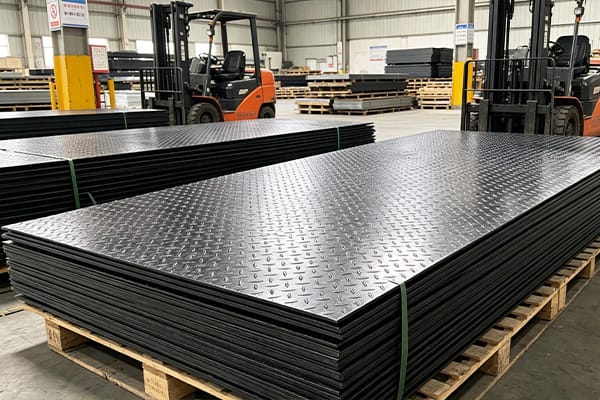
HDPE and UHMWPE both belong to the polyethylene family. As a result, they share several useful characteristics.
Both can offer good resistance to moisture and many chemicals. Both are relatively lightweight compared with steel, do not rust, and can be manufactured into industrial sheets or components.
That similarity is why HDPE vs UHMWPE is sometimes reduced to a simple “standard grade versus premium grade” comparison.
That is not a very useful way to select engineering plastics.
HDPE is widely used where toughness, general fabrication, panel performance, chemical resistance, and outdoor durability are important. UHMWPE becomes particularly valuable when the contact surface itself is causing the engineering problem—for example, when abrasive bulk material passes over a liner or a conveyor chain continuously slides against a guide.
The right question is therefore not:
Which material is universally better?
It is:
Which material has the properties that matter most in this specific operating environment?
HDPE vs UHMWPE: The Key Difference Starts With Molecular Weight
The most important technical difference between these materials begins at the molecular level.
UHMWPE is characterized by an extremely high molecular weight compared with conventional HDPE. Its very long polymer chains contribute to characteristics such as high impact toughness, strong abrasion resistance, and excellent performance in repeated sliding applications.
For industrial procurement teams, this means an HDPE vs UHMWPE decision is more than a change in product grade. Molecular structure can influence abrasion behavior, impact performance, friction, processing characteristics, and long-term service life.
Formal material standards can also be useful when evaluating specifications. ASTM D4020 covers ultra-high-molecular-weight polyethylene molding and extrusion materials, while ISO 21304-1 provides a designation system for PE-UHMW materials.
These standards are useful references, but a material designation alone still cannot determine whether a specific component will perform correctly in its working environment.
HDPE vs UHMWPE at a Glance
| Selection Factor | HDPE | UHMWPE | Typical Selection Direction |
|---|---|---|---|
| General sheet fabrication | Excellent | Good | HDPE often suits broad panel applications |
| Abrasive sliding wear | Good | Excellent | UHMWPE normally deserves consideration |
| Low-friction guiding | Good | Excellent | UHMWPE often preferred |
| Repeated impact | Good | Excellent | UHMWPE often preferred |
| Ground protection panels | Excellent | Application-dependent | HDPE is often practical |
| Chute and hopper liners | Application-dependent | Excellent | UHMWPE often preferred |
| Conveyor guides and wear strips | Application-dependent | Excellent | UHMWPE often preferred |
| CNC wear components | Good | Excellent for wear-focused parts | Select according to duty |
| Moisture resistance | Strong | Strong | Both can work well |
| Chemical resistance | Strong in many environments | Strong in many environments | Verify chemical and temperature |
| Large fabricated panels | Common application | Possible with design review | HDPE frequently used |
| Sliding machinery parts | Possible | Strong application fit | UHMWPE frequently used |
This HDPE vs UHMWPE table should be treated as a screening tool rather than a final specification.
Two components manufactured from the same polymer can perform differently because of material grade, thickness, additives, temperature, load duration, mounting method, support spacing, surface pressure, and manufacturing quality.
HDPE vs UHMWPE for Wear and Sliding Contact
Wear is one of the areas where the distinction becomes much clearer.
In a chute, conveyor guide, wear strip, sliding block, scraper, or guide rail, the surface can experience thousands or millions of contact cycles. A material may perform well under a static load but lose thickness rapidly when abrasive particles or moving components repeatedly pass across it.
In a practical HDPE vs UHMWPE wear comparison, UHMWPE usually becomes more attractive as abrasion and sliding frequency increase.
Its very long molecular chains, toughness, and low-friction behavior make UHMWPE particularly suitable for repeated sliding and abrasive contact.
Common UHMWPE wear applications include:
- chute liners
- hopper liners
- bunker liners
- conveyor wear strips
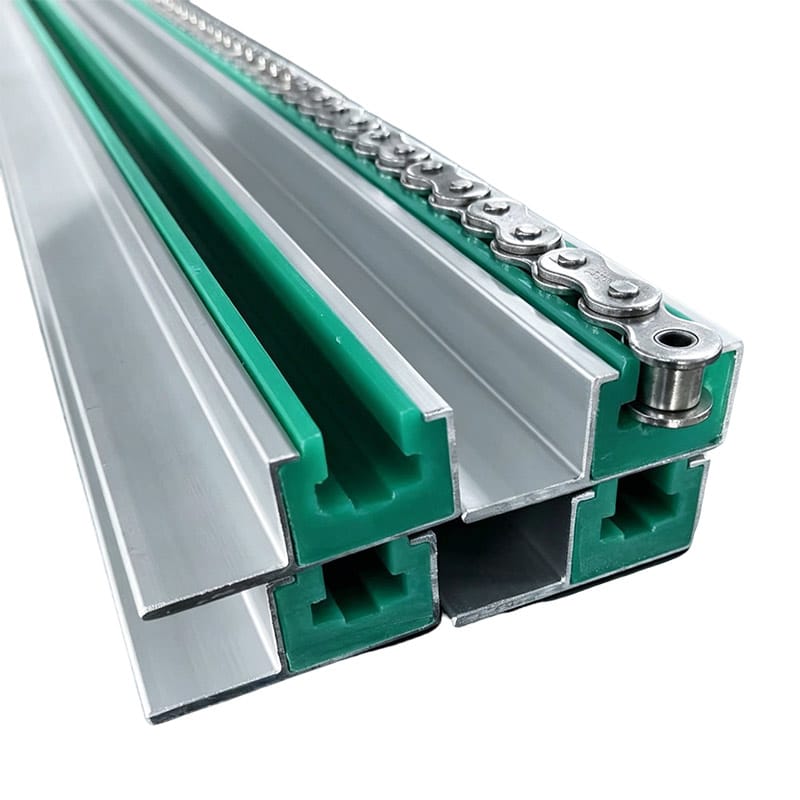
- chain guides
- guide rails
- sliding blocks
- scrapers
- replaceable wear plates
For bulk material handling systems, the liner is not only there to protect the underlying steel. Surface behavior can also influence how efficiently material moves through the equipment.
When abrasion, sticking, or repeated impact is causing maintenance problems, reviewing dedicated UHMWPE wear liner solutions can provide a more application-specific starting point.
HDPE can still perform effectively where abrasion is moderate.
The important distinction is whether wear is merely present or whether wear is the main reason the component is failing.
When wear dominates service life, UHMWPE deserves much closer consideration.
HDPE vs UHMWPE for Impact and Mechanical Shock
Impact loading should not be confused with steady compression.
A panel may perform well while carrying a distributed static load but behave very differently when exposed to dropped material, sudden contact, vibration, or repeated mechanical shock.
In HDPE vs UHMWPE selection, UHMWPE stands out because of its high impact toughness.
This makes UHMWPE especially interesting for:
- mining equipment
- bulk material transfer points
- impact areas inside hoppers
- machinery wear blocks
- protective bumpers
- components receiving repeated mechanical contact
However, higher impact toughness does not mean UHMWPE should automatically replace HDPE in every structural or panel application.
A large panel might be controlled by:
- stiffness
- span
- deflection
- fastening
- support spacing
- concentrated loading
This is a recurring lesson throughout HDPE vs UHMWPE selection: the best material is determined by the dominant engineering requirement rather than the most impressive value on a technical data sheet.
HDPE vs UHMWPE for Ground Protection and Temporary Access
Ground protection is an excellent example of an application where HDPE can be the more practical material.
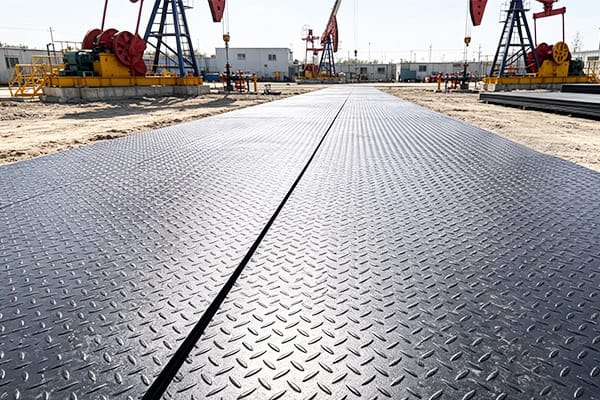
Temporary access mats and construction ground protection panels need to distribute vehicle and equipment loads across the ground while protecting soil, grass, pavement, or prepared work areas.
They may also need to resist:
- water
- mud
- repeated outdoor handling
- vehicle movement
- uneven terrain
- site contamination
Extreme sliding abrasion is not necessarily the primary design problem.
For these applications, HDPE can offer an effective combination of toughness, outdoor suitability, fabrication flexibility, and repeat use.
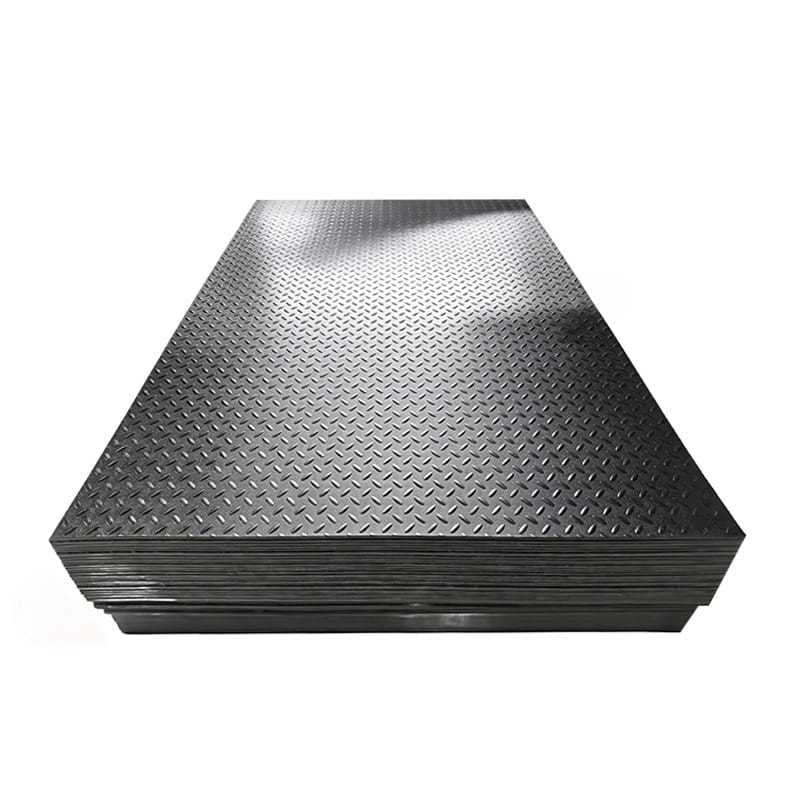
Industrial buyers evaluating temporary construction access can review HDPE temporary road mats designed for equipment access and surface protection.
However, selecting a mat requires more than choosing HDPE.
Equipment Load
A tracked excavator, wheeled loader, truck, crane, and aerial platform distribute loads very differently.
Ground Bearing Condition
Firm dry ground presents a different problem from saturated soil, sand, mud, or landscaped surfaces.
Contact Area
Equipment weight alone cannot determine ground pressure. Tire size, track area, outriggers, and panel contact all influence load distribution.
Mat Geometry
Thickness, surface pattern, size, connection design, and unsupported span can affect field performance.
Vehicle Movement
Turning, braking, acceleration, and repeated traffic can create stresses that are very different from a stationary load.
This is why a generic HDPE vs UHMWPE property comparison cannot determine whether a particular mat is suitable for a jobsite.
The actual load and ground condition must remain part of the selection process.
HDPE vs UHMWPE for Machining and Fabrication
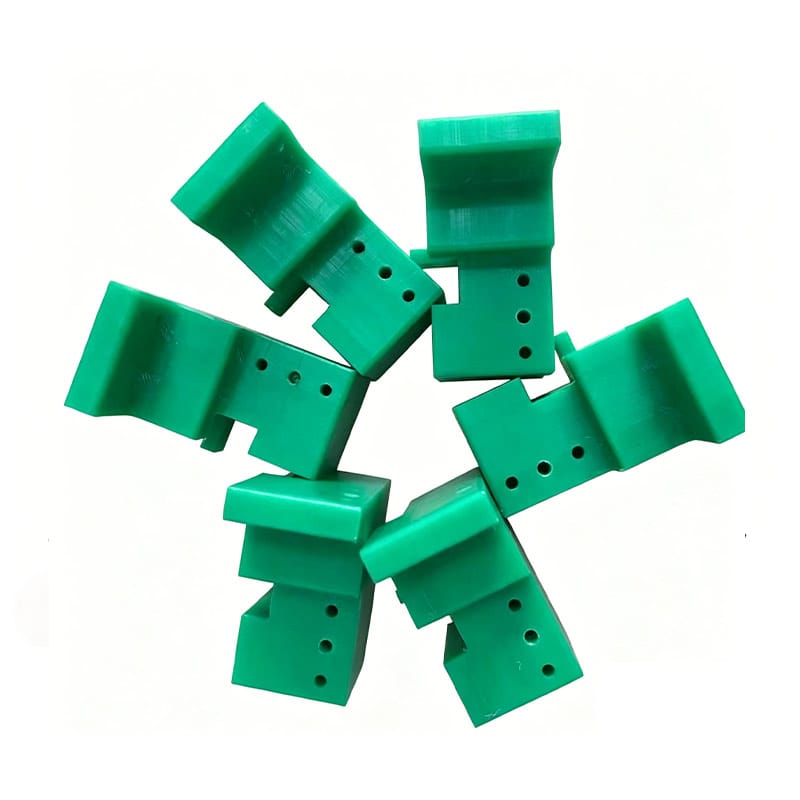
Both materials can be converted into industrial components, but their processing behavior is not identical.
HDPE is commonly used for general sheet fabrication, protective panels, boards, guards, and other fabricated structures.
UHMWPE is frequently machined into more specialized wear components where low friction, impact resistance, and sliding performance are important.
In HDPE vs UHMWPE machining, one of the biggest mistakes is treating either polymer like metal.
Machined plastic parts can respond to:
- cutting heat
- tool condition
- clamping pressure
- machining sequence
- wall thickness
- component geometry
- temperature changes
Long, thin components also behave differently from compact blocks or thick wear plates.
For CNC parts, engineering drawings should clearly identify:
- overall dimensions
- mounting holes
- grooves and slots
- critical tolerances
- mating surfaces
- operating load
- temperature
- sliding direction
- abrasion conditions
- mounting method
Components such as guides, rollers, sleeves, scrapers, wear strips, and sliding blocks can be produced as custom UHMWPE machined parts according to drawings, samples, or equipment dimensions.
The central lesson from HDPE vs UHMWPE machining is simple:
Machinable does not mean interchangeable.
Material selection and dimensional requirements should be evaluated together.
HDPE vs UHMWPE for Chemicals, Moisture, and Outdoor Use
Chemical and moisture resistance are strong reasons engineers use polyethylene materials.
Both HDPE and UHMWPE are suitable for many environments where rust, water exposure, washdown, or chemical contact can create problems for conventional metallic components.
However, an HDPE vs UHMWPE comparison should never treat “chemical resistant” as meaning “resistant to everything.”
Compatibility depends on factors such as:
- the specific chemical
- concentration
- operating temperature
- exposure time
- mechanical stress
- cleaning chemicals
- repeated cycling
The same principle applies outdoors.
A material intended for long-term outdoor service may require an appropriate UV-stabilized grade. Buyers should not assume that every natural, colored, recycled, or modified polyethylene sheet will provide identical weathering performance.
For UHMWPE procurement, formal material references such as ASTM D4020 and ISO 21304-1 are useful starting points for understanding material classification.
HDPE vs UHMWPE Selection Should Start With the Failure Mode
A much more reliable material selection process starts with one question:
Why is the existing component failing?
This approach makes HDPE vs UHMWPE selection more practical because different industries experience different dominant failure mechanisms.
Bulk Material Handling: Abrasion or Material Buildup
Chutes, hoppers, bunkers, and transfer points can experience a combination of abrasive wear, material sticking, impact, and continuous flow.
When rapid liner wear or sliding abrasion is the main problem, UHMWPE is frequently the stronger candidate.
However, liner performance also depends on:
- liner thickness
- mounting arrangement
- fastener positioning
- material flow direction
- substrate condition
- thermal movement allowance
A high-performance liner material can still fail prematurely when the installation design is poor.
Conveyor Systems: Friction and Guide Wear
Conveyor guides and wear strips experience repeated sliding contact.
Here, low friction and wear resistance may matter more than structural stiffness.
UHMWPE is therefore commonly considered for:
- chain guides
- conveyor wear strips
- guide profiles
- support rails
- sliding contact components
The site’s UHMWPE chain guide products are designed around this type of repeated conveyor contact.
Selection should also account for conveyor speed, chain loading, contamination, lubrication, alignment, and operating temperature.
Construction Sites: Ground Damage
Construction ground protection presents a different engineering problem.
Instead of protecting equipment from abrasive bulk material, the mat distributes vehicle loads across the ground.
HDPE can therefore be a practical material for reusable temporary road mats and construction access systems.
Industrial Machinery: Repeated Contact
For custom machinery components, both materials may be candidates.
Ask:
- Is the component sliding or mainly stationary?
- Is abrasive contamination present?
- Does the part receive repeated impact?
- Is stiffness more important than low friction?
- Is the component continuously supported?
- Are close machining tolerances required?
- Will it operate outdoors?
- Will chemicals contact the material?
Answering those questions is more useful than trying to identify a universal winner in HDPE vs UHMWPE.
When HDPE Is the Smarter Choice
HDPE is often an excellent material when the project requires a versatile engineering sheet without extreme sliding-wear demands.
In an HDPE vs UHMWPE procurement decision, HDPE deserves serious consideration for:
- temporary access mats
- ground protection panels
- general fabricated sheets
- protective guards
- large outdoor panels
- chemically exposed panels
- applications with limited abrasive sliding
Its suitability for broad fabrication makes HDPE especially useful where the component behaves primarily as a panel rather than a wear surface.
One procurement mistake is automatically upgrading to UHMWPE without identifying what performance problem the upgrade is expected to solve.
More specialized does not automatically mean more suitable.
When UHMWPE Is the Smarter Choice
UHMWPE becomes increasingly attractive as abrasion, sliding, impact, friction, and repeated contact become central to the application.
For HDPE vs UHMWPE selection, common UHMWPE applications include:
- chute liners
- hopper liners
- conveyor wear strips
- chain guides
- guide rails
- sliding blocks
- wear plates
- scrapers
- machined replacement parts
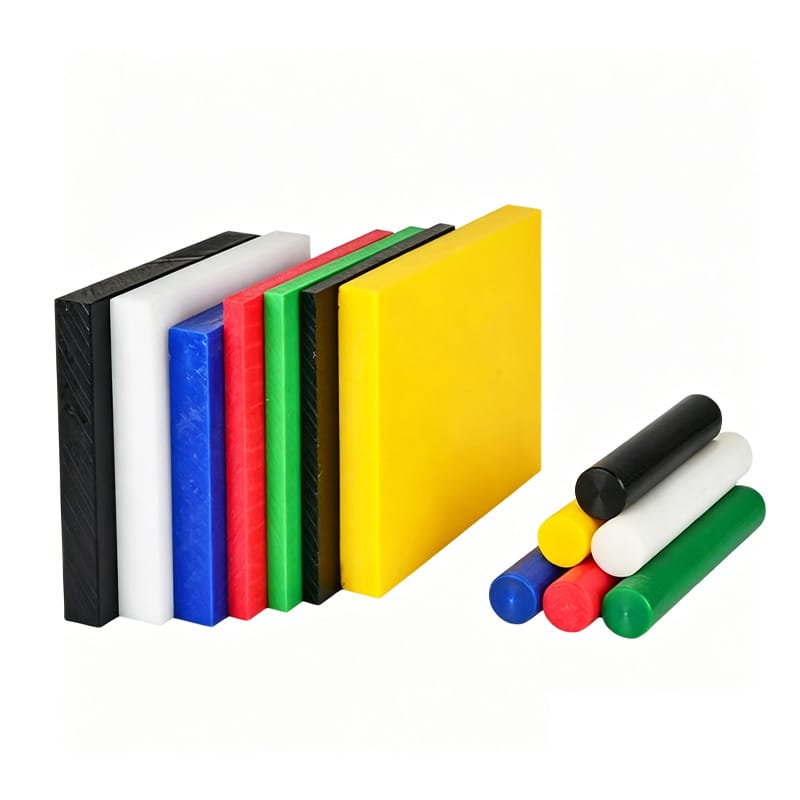
Industrial projects that begin with sheet stock can review UHMWPE engineering plastic sheets for liners, wear plates, guides, and CNC-machined components.
UHMWPE is particularly worth evaluating when an existing component is:
- wearing away
- scoring
- dragging
- creating high friction
- receiving repeated impact
- generating excessive contact noise
- being replaced too frequently
In those situations, the material’s wear-focused performance can directly address the underlying maintenance problem.
Questions Buyers Should Answer Before Ordering
Material selection becomes much easier when suppliers receive useful application information.
A resin name by itself is not enough to make a reliable recommendation.
What Does the Component Actually Do?
State whether it is:
- supporting
- sliding
- guiding
- lining
- protecting
- scraping
- distributing load
What Contacts the Surface?
Examples might include:
- steel chain
- mineral aggregate
- coal
- sand
- packaging
- tires
- tracks
- soil
- another plastic component
What Is the Current Failure Pattern?
Useful information includes:
- worn grooves
- cracking
- surface loss
- deformation
- sticking
- noise
- impact damage
- edge failure
What Loads Are Present?
Provide available information about:
- static load
- dynamic load
- impact
- contact area
- mounting positions
- equipment dimensions
What Is the Working Environment?
Include:
- operating temperature
- outdoor exposure
- moisture
- chemicals
- dust
- washdown
- contamination
Are Drawings Available?
A dimensioned technical drawing is ideal.
When drawings are unavailable, physical samples, equipment measurements, sketches, and photographs can still help define the component.
Providing this information makes an HDPE vs UHMWPE recommendation much more meaningful than simply comparing generic material data.
FAQ
Is UHMWPE Always Stronger Than HDPE?
No.
“Stronger” can refer to impact strength, stiffness, tensile properties, abrasion resistance, compressive performance, or many other characteristics.
UHMWPE is particularly attractive for abrasion, impact, and low-friction contact. HDPE can be extremely effective for general fabrication, structural panels, temporary road mats, and ground protection applications.
The correct choice depends on the application.
What Is the Main Difference Between HDPE and UHMWPE?
One of the most important differences is molecular weight.
UHMWPE has substantially longer polymer chains, which contribute to its characteristic impact, friction, and wear performance.
Is UHMWPE Better Than HDPE for Wear Liners?
For severe sliding abrasion, chute liners, hopper liners, and repeated material contact, UHMWPE is generally the material that deserves first consideration.
The complete liner design must still account for thickness, mounting, temperature, impact, and conveyed material.
Is HDPE Suitable for Heavy Equipment Ground Protection?
Yes.
HDPE is well suited to many ground protection and temporary access applications when mat dimensions and construction are matched to the equipment and ground conditions.
Equipment weight should not be evaluated alone. Contact area, ground bearing capacity, panel support, turning forces, and soil conditions also matter.
Which Material Is Better for Conveyor Guides?
UHMWPE is often preferred because conveyor guides frequently experience repeated sliding, friction, and wear.
Final selection should also consider:
- chain type
- speed
- load
- contamination
- alignment
- operating temperature
Can UHMWPE Be CNC Machined?
Yes.
UHMWPE can be CNC machined into:
- guides
- wear strips
- rollers
- sleeves
- scrapers
- sliding blocks
- custom-shaped industrial components
Machining methods should account for heat generation, clamping, dimensions, and material movement.
Do HDPE and UHMWPE Resist Chemicals?
Both resist many common chemicals and moisture.
However, suitability depends on the exact substance, concentration, temperature, exposure period, and mechanical loading.
Chemical compatibility should always be evaluated for the specific application.
How Do I Decide Between HDPE and UHMWPE for a Custom Part?
Start with the dominant failure mode.
When severe sliding wear, abrasion, or repeated impact is the primary problem, UHMWPE should normally be evaluated first.
When the project requires a general fabricated sheet, large protective panel, temporary access mat, or ground protection system, HDPE may be the more logical starting point.
For projects with unusual loads or operating conditions, drawings and application details can be submitted through Paowo Group’s contact page for material and manufacturing review.
Conclusion
The most useful way to think about HDPE vs UHMWPE is not:
Which material is better?
Instead, ask:
Which material solves the dominant engineering problem?
HDPE is a versatile option for fabricated sheets, temporary access, ground protection, protective panels, and many general industrial applications.
UHMWPE becomes particularly valuable where components face abrasion, repeated sliding, friction, impact, or frequent replacement.
A successful specification should go beyond the polymer name. Thickness, geometry, grade, UV stabilization, support, fastening, temperature, chemical exposure, contact pressure, and machining tolerance can all influence service life.
For industrial buyers, the strongest HDPE vs UHMWPE decision starts with the application, identifies the real failure mode, and then matches the material and component design to the actual working conditions.