Bottling and packaging conveyors may look clean and lightweight compared with mining or heavy industrial equipment, but the wear conditions can still be demanding.
A high-speed bottling line can operate for long shifts while chains, bottles, cans, cartons and containers move continuously through straight sections, curves, accumulation areas, rinsing zones and transfer points.
That makes bottling conveyor chain guides an important part of conveyor reliability.
The guide does much more than keep a chain in position. It influences:
- Chain tracking
- Sliding friction
- Noise
- Heat generation
- Wear
- Product stability
- Maintenance intervals
- Conveyor cleanliness
UHMWPE is widely used for bottling conveyor chain guides because it combines low friction, good wear resistance, toughness and low moisture absorption.
However, selecting the right guide requires more than asking for “white UHMWPE rail.”
The correct profile depends on the chain type, speed, load, curve radius, mounting system, operating temperature, cleaning environment and actual wear pattern.
For packaging-line builders, beverage-equipment manufacturers and maintenance teams, these inputs are more useful than choosing a guide only from catalog dimensions.
This guide explains how to evaluate bottling conveyor chain guides for beverage, food and packaging systems and what information should be prepared before ordering custom UHMWPE chain guides.
Why Bottling Conveyor Chain Guides Matter

A conveyor chain follows a defined path through the machine.
The guide supports that path and helps maintain the intended relationship between:
- Chain
- Sprockets
- Products
- Conveyor frame
- Transfer points
In a bottling line, poor guide performance can contribute to:
- Chain wander
- Increased friction
- Noise
- Bottle instability
- Uneven wear
- Frequent replacement
- Unexpected line stoppages
Because packaging lines often operate at high cycle rates, even a small mechanical issue can repeat thousands of times during a production shift.
That is why bottling conveyor chain guides should be treated as functional wear components rather than simple plastic strips.
Why UHMWPE Is Commonly Used in Bottling Conveyor Chain Guides
UHMWPE has several characteristics that make it suitable for many conveyor applications.
Typical advantages include:
- Low surface friction
- Good sliding wear resistance
- Impact toughness
- Low moisture absorption
- Resistance to many common chemicals
- Easy machining into custom profiles
These characteristics make UHMWPE useful for:
- Chain guides
- Wear strips
- Product guide rails
- Curved conveyor tracks
- Sliding support rails
For bottling and packaging systems, low-friction behavior can be especially valuable because the conveyor may run continuously for long periods.
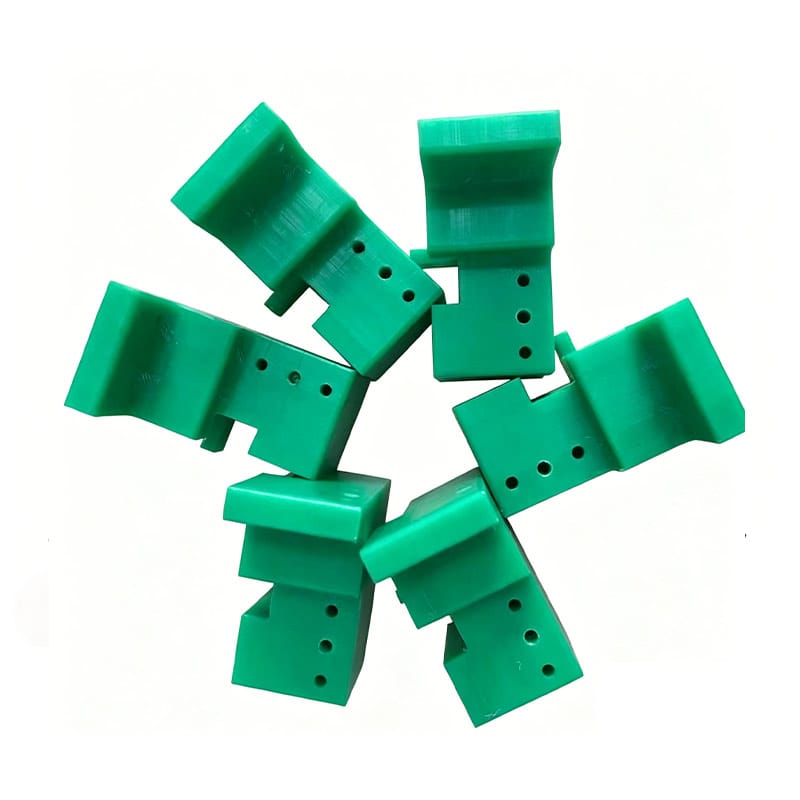
Paowo Group supplies UHMWPE chain guides for industrial conveyor applications and can produce profiles according to drawings, samples and chain specifications.
Start with the Exact Conveyor Chain
The first step in selecting bottling conveyor chain guides is identifying the chain.
Do not begin with the guide.
The guide profile should match the actual chain geometry.
Useful information includes:
- Chain manufacturer
- Chain model
- Chain pitch
- Chain width
- Chain height
- Roller or plate dimensions
- Technical drawing
Descriptions such as “standard bottle chain” or “plastic packaging chain” are too broad.
Two chains that look similar may require different guide clearances.
Why Chain-to-Guide Clearance Matters
The chain needs enough clearance to move freely while still being controlled.
If a guide is too tight, possible results include:
- Binding
- Heat buildup
- Increased drive load
- Accelerated guide wear
- Noise
If the guide is too loose, the chain may:
- Move laterally
- Impact the guide
- Track inconsistently
- Create product instability
For bottling conveyor chain guides, the target is controlled movement rather than minimum possible clearance.
Straight Sections and Curves Need Different Attention
A straight chain path creates different contact conditions from a curved section.
In a straight section, the chain may have relatively limited side pressure.
In a curve, lateral force increases because the guide is forcing the chain to change direction.
This often makes curved bottling conveyor chain guides more wear-sensitive.
Important curve inputs include:
- Curve radius
- Arc angle
- Chain type
- Conveyor speed
- Product load
A guide that performs well on a straight run may wear much faster in a tight curve.
Why Curve Radius Matters
A smaller curve radius generally creates a more demanding guidance condition.
The chain presses harder against the side of the guide as it follows the curve.
This can increase:
- Friction
- Temperature
- Side-wall wear
- Chain load
If a packaging line has repeated guide failures in curved sections, do not immediately assume the UHMWPE grade is poor.
Also inspect:
- Radius
- Alignment
- Speed
- Chain condition
- Mounting
For bottling conveyor chain guides, the mechanical path is often as important as the material.
Conveyor Speed Has a Major Effect on Guide Wear
Speed influences how much sliding occurs between the chain and guide over time.
Higher conveyor speed means:
- More sliding distance per hour
- More frictional interaction
- Potentially more heat
- Faster accumulation of wear
When requesting bottling conveyor chain guides, include the line speed whenever possible.
Useful units include:
- m/min
- m/s
- ft/min
If the line uses multiple speeds, provide both normal and maximum operating speed.
High-Speed Bottling Lines Need Better Wear Monitoring
A guide can look fine during installation and still develop significant wear after continuous operation.
For high-speed lines, establish regular inspection points.
Measure:
- Groove width
- Remaining wall thickness
- Side wear
- Joint condition
Record the same locations over time.
This makes bottling conveyor chain guides easier to replace based on actual wear rather than waiting for failure.
Product Accumulation Changes Conveyor Loading
Bottling lines often include accumulation zones.
Products may stop while the conveyor chain continues moving.
This can change:
- Chain load
- Sliding resistance
- Product pressure
- Guide loading
Accumulation areas can therefore wear differently from normal transport sections.
If guide wear is concentrated near accumulation zones, include that information when reviewing the system.
For bottling conveyor chain guides, operating mode can be just as important as line speed.
Bottle Stability Depends on More Than the Chain Guide
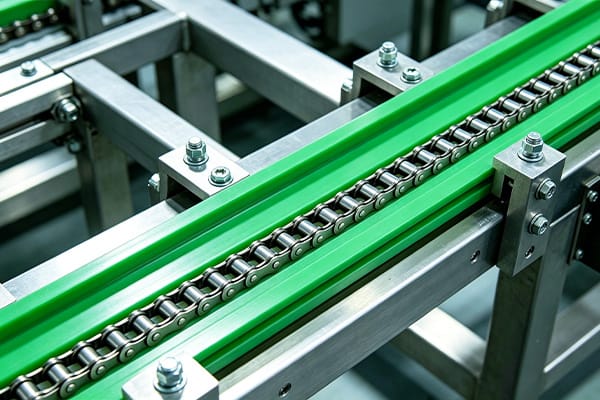
The chain guide controls the conveyor chain, but bottle stability also depends on:
- Product guide rails
- Conveyor width
- Transfer geometry
- Line speed
- Container shape
- Accumulation pressure
A chain guide problem can contribute to bottle instability if the chain wanders or vibrates.
However, if bottles tip or jam, inspect the entire conveyor path rather than changing only the UHMWPE guide.
Noise Can Be a Useful Diagnostic Signal
Packaging lines are often sensitive to noise because equipment operates close to workers and other machinery.
UHMWPE is commonly used partly because its sliding characteristics can help create quieter running surfaces than direct metal-to-metal contact.
However, rising noise levels may indicate:
- Worn chain
- Poor alignment
- Loose guide
- Excessive clearance
- Tight guide profile
- Damaged sprocket
- Contamination
A noisy bottling conveyor chain guide should therefore be inspected as part of the system.
Replacing the plastic without identifying the mechanical cause may only provide temporary improvement.
Heat Buildup Is a Warning Sign
If a chain guide becomes unusually warm, investigate the contact condition.
Potential causes include:
- Excessive chain tension
- Tight guide clearance
- Misalignment
- High speed
- Poor lubrication condition
- Contamination
Heat can accelerate dimensional change and wear.
For bottling conveyor chain guides, record actual surface temperature if overheating is suspected.
“Feels hot” is less useful than a measured temperature.
Lubricated vs Dry-Running Bottling Conveyors
Some packaging conveyors operate with lubrication.
Others are designed for reduced-lubrication or dry-running conditions.
The correct approach depends on the chain and equipment design.
Lubrication can affect:
- Friction
- Wear
- Product cleanliness
- Cleaning
- Contamination
For a bottling conveyor chain guide RFQ, state whether the conveyor operates:
- Dry
- With intermittent lubrication
- With continuous lubrication
- With water-based lubrication
- Under washdown conditions
This helps the supplier understand the actual sliding environment.
Washdown Changes Material and Mounting Requirements
Beverage and food-packaging lines may be washed frequently.
This means bottling conveyor chain guides can be exposed to:
- Water
- Cleaning chemicals
- Temperature changes
- Repeated wetting and drying
UHMWPE’s low moisture absorption can be useful in these environments.
However, the entire assembly still needs to be designed for washdown.
Check:
- Fastener material
- Support corrosion
- Drainage
- Debris traps
- Cleaning access
A good guide should not create difficult-to-clean pockets around the mounting structure.
Food-Contact Requirements Should Be Specified
Not every UHMWPE grade should automatically be described as food-contact compliant.
If the guide will be used in a food or beverage environment where regulatory documentation is required, include that requirement in the RFQ.
Ask for documentation for the exact material supplied.
Do not rely only on general statements such as:
“UHMWPE is food grade.”
For bottling conveyor chain guides, material traceability may be important when the guide is close to exposed product or food-contact areas.
Color Can Help with Line Identification
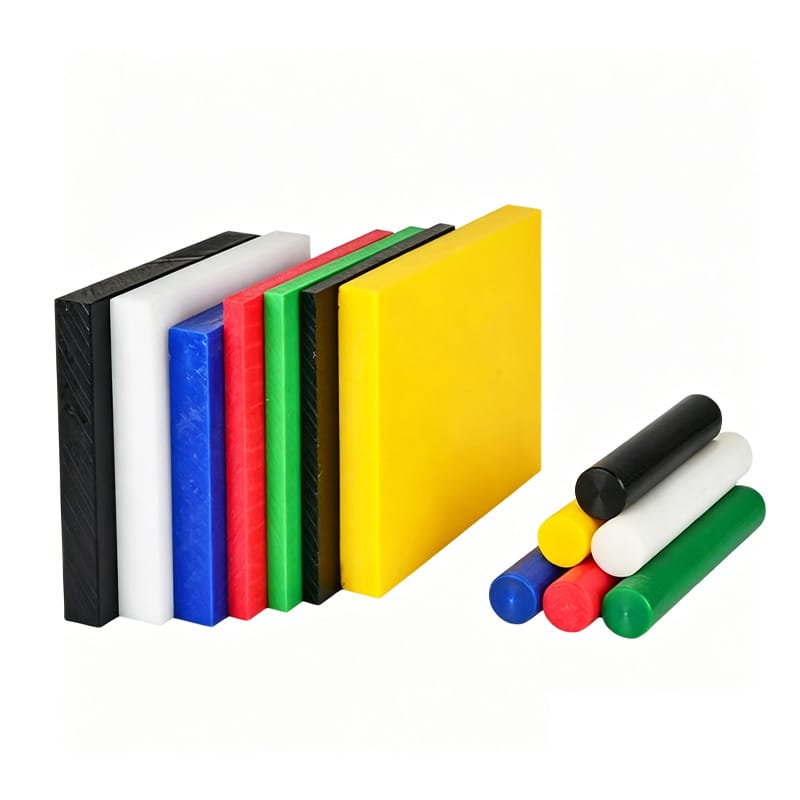
UHMWPE guides can be supplied in different colors depending on material and production requirements.
Color may be used for:
- Line identification
- Equipment grouping
- Maintenance coding
- Visual contrast
However, color should not be treated as proof of material grade.
A blue or white guide is not automatically equivalent to another guide of the same color.
The actual UHMWPE specification matters more.
Why Guide Profile Design Matters
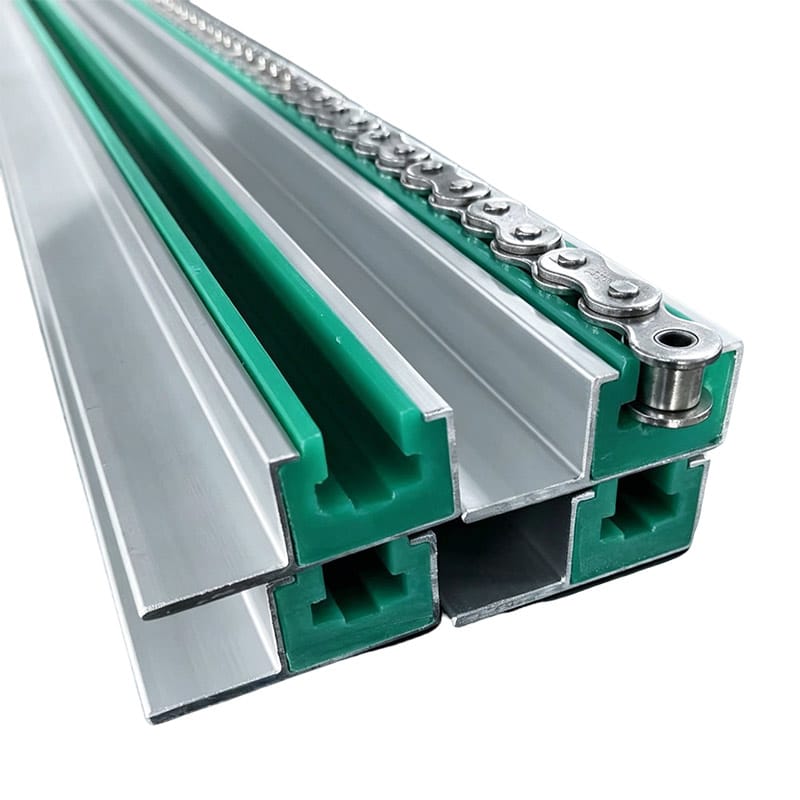
The cross-section of bottling conveyor chain guides determines how the chain is supported.
Important profile dimensions include:
- Overall width
- Overall height
- Groove width
- Groove depth
- Side-wall thickness
- Mounting section
A profile that is too thin may wear rapidly or deform.
A profile that is too bulky may create unnecessary material use or interfere with surrounding equipment.
The guide should be designed around the chain and machine geometry.
Mounting Method Affects Guide Performance
Common mounting methods include:
- Bolted holes
- Slotted holes
- Metal carrier rails
- Snap-in profiles
- Custom brackets
The mounting system should keep the guide aligned while allowing appropriate movement where required.
Long UHMWPE guides may require attention to thermal expansion.
If every point is rigidly fixed, temperature changes can contribute to:
- Bowing
- Joint movement
- Misalignment
For long bottling conveyor chain guides, fixed and floating mounting concepts may be considered depending on the design.
Support Spacing Can Cause Localized Wear
A guide is only as stable as its support.
If support spacing is too wide, the UHMWPE profile can deflect between brackets.
This may create:
- Uneven chain contact
- Vibration
- Local wear
- Noise
If wear repeats at regular intervals, compare those locations with support brackets.
The pattern may show that the guide is bending between supports.
Joint Design Matters on Long Packaging Lines
Long conveyor routes often use multiple guide sections.
Joints should be aligned carefully.
Problems can occur if sections create:
- Steps
- Gaps
- Overlaps
- Misaligned grooves
A chain passing over a step thousands of times per shift can create localized impact and wear.
For bottling conveyor chain guides, joint quality can influence both chain smoothness and noise.
How Contamination Affects Bottling Conveyor Chain Guides
Packaging plants are usually cleaner than heavy industrial sites, but contamination still occurs.
Possible contaminants include:
- Broken packaging
- Labels
- Plastic fragments
- Dust
- Product residue
- Metal particles
If debris becomes trapped between the chain and guide, it can create abrasive wear.
Inspect high-wear guides for:
- Scratches
- Embedded particles
- Rough grooves
A cleaning problem can sometimes look like a material-quality problem.
Why Chain Condition Matters
A worn chain can damage a new guide.
Inspect:
- Chain elongation
- Rollers
- Links
- Pins
- Sprocket engagement
If the chain is heavily worn, a new UHMWPE guide may quickly develop the same abnormal wear pattern.
For bottling conveyor chain guides, replacement should therefore include a chain-condition review.
Should Worn Guides Be Copied Exactly?
Not always.
A worn guide may have:
- Enlarged groove width
- Reduced side-wall thickness
- Distorted mounting holes
If the supplier copies the damaged profile exactly, the new guide may begin with excessive clearance.
A better replacement process uses:
- Chain dimensions
- Original drawings
- Unworn surfaces
- Machine mounting references
The goal is to reproduce the intended profile, not the worn condition.
Machined vs Extruded Chain Guides
Both manufacturing approaches can be relevant.
Machined UHMWPE Guides
Machining can be useful for:
- Low quantities
- Custom profiles
- Prototype parts
- Complex mounting features
Extruded UHMWPE Guides
Extrusion can be attractive for:
- Long constant profiles
- Repeated production
- Higher-volume standard sections
The best route depends on:
- Cross-section
- Quantity
- Length
- Tolerance
- Tooling economics
For bottling conveyor chain guides, buyers should let the supplier compare the actual geometry and annual demand before deciding on manufacturing method.
What Information Should You Send for a Bottling Conveyor Guide Quote?
A useful inquiry should include the complete conveyor conditions.
Chain Information
Provide:
- Chain manufacturer
- Chain model
- Chain drawing
- Pitch
- Width
Guide Geometry
Provide:
- Cross-section
- Overall length
- Section length
- Curve radius
- Quantity
Operating Conditions
Provide:
- Line speed
- Load
- Operating temperature
- Hours per day
- Lubrication condition
- Washdown frequency
Mounting Information
Provide:
- Hole pattern
- Carrier profile
- Support spacing
- Fastener type
Existing Wear Information
Provide:
- Current material
- Service life
- Wear pattern
- Noise issues
- Heat issues
- Photographs
This allows a supplier to evaluate bottling conveyor chain guides based on actual line conditions.
Bottling Conveyor Chain Guides FAQ
Why Is UHMWPE Used for Bottling Conveyor Chain Guides?
UHMWPE is commonly used because it combines low friction, wear resistance, toughness and low moisture absorption, which can suit continuous conveyor applications.
Can UHMWPE Chain Guides Be Used on High-Speed Packaging Lines?
Yes, but guide profile, speed, chain condition, alignment, temperature and mounting need to be evaluated together.
Why Do Chain Guides Wear Faster in Curves?
Curves create additional side force as the chain changes direction, increasing contact against the guide wall.
Can Chain Guides Be Used in Washdown Areas?
UHMWPE is commonly suitable for wet environments, but the complete mounting system and any required regulatory documentation should also be reviewed.
Do Bottling Conveyor Chain Guides Need Lubrication?
That depends on the conveyor and chain design. Some lines operate dry while others use lubrication. Follow the chain and equipment manufacturer’s requirements.
Can a Worn Guide Be Used as a Sample?
Yes, but worn dimensions should not automatically be copied. Chain dimensions and unworn reference surfaces should also be used.
Can Paowo Produce Curved Chain Guides?
Yes. Custom UHMWPE chain guides can be produced according to profile, radius, length and mounting requirements.
What Causes Chain Guide Overheating?
Possible causes include tight clearance, excessive tension, high speed, misalignment, contamination or lubrication problems.
Can Chain Guides Be Made in Different Colors?
Yes, depending on the UHMWPE grade and manufacturing requirements. Color availability and any regulatory requirements should be confirmed before production.
Bottling Conveyor Chain Guide RFQ Checklist
Before requesting a quotation, prepare the following.
Chain Data
- Chain manufacturer
- Chain model
- Chain pitch
- Chain width
- Technical drawing
Guide Profile
- Overall width
- Overall height
- Groove width
- Groove depth
- Cross-section drawing
Conveyor Geometry
- Straight or curved
- Curve radius
- Section length
- Total length
- Quantity
Operating Conditions
- Conveyor speed
- Product load
- Temperature
- Operating hours
- Washdown
- Lubrication condition
Mounting
- Carrier type
- Hole pattern
- Slot dimensions
- Support spacing
- Fasteners
Existing Wear
- Current material
- Service life
- Wear photographs
- Heat
- Noise
- One-sided wear
Material and Quality Requirements
- UHMWPE grade
- Color
- Food-contact documentation if required
- First article inspection
- Dimensional inspection
- Batch identification
A complete RFQ helps the manufacturer quote a functional conveyor component rather than a generic length of UHMWPE.
Conclusion
Reliable bottling conveyor chain guides depend on more than the material name.
UHMWPE can provide a strong combination of low friction, wear resistance, toughness and moisture resistance for beverage and packaging conveyors, but the final performance depends on how the guide interacts with the chain and the machine.
The most important selection inputs include:
- Chain type
- Profile geometry
- Conveyor speed
- Curve radius
- Product load
- Operating temperature
- Lubrication
- Washdown
- Mounting
- Existing wear pattern
Curved sections, accumulation zones and high-speed lines deserve particular attention because they can create higher side loading and friction.
For replacement projects, avoid copying a worn guide without checking the chain and original geometry.
For new OEM projects, provide controlled drawings and operating conditions so the guide can be designed around the actual conveyor rather than copied from a generic profile.
Paowo Group manufactures UHMWPE chain guides and customized conveyor system components for bottling, packaging and industrial conveyor systems.
Request a Quote
Send Paowo Group your:
- Chain manufacturer and model
- Chain drawing
- Guide profile
- Straight and curved section dimensions
- Conveyor speed
- Operating temperature
- Lubrication condition
- Washdown requirements
- Existing wear photos
- Required quantity
These inputs can be used to review the most suitable UHMWPE guide profile, manufacturing route and mounting configuration before quotation.