Choosing between PE1000 and PE500 is not simply a matter of selecting the polyethylene grade with the higher number. For engineers, equipment manufacturers, maintenance teams, and industrial buyers, the more useful question is: which material better matches the actual wear mechanism, mechanical load, operating environment, machining requirements, and budget of the application?
Both materials belong to the polyethylene family and are widely used for industrial components where low friction, chemical resistance, impact resistance, and relatively low weight are desirable. However, PE1000 and PE500 are not interchangeable in every application.
PE1000 is generally associated with applications where sliding wear, abrasion, impact, and low-friction movement are major concerns. PE500 can be a practical choice when good toughness and wear performance are required but the application does not justify moving to UHMWPE.
Understanding these differences can help buyers avoid both under-specifying and over-specifying an industrial plastic component.
Table of Contents
What Are PE1000 and PE500?
PE1000 and PE500 are engineering polyethylene grades commonly specified for sheets, wear strips, liners, guides, machined components, and other industrial parts.
The terminology is often associated with the approximate molecular-weight class of the polyethylene material, although actual specifications should always be confirmed from the supplier’s technical documentation rather than inferred from the commercial grade name alone.
What Is PE1000?
PE1000 is commonly used as a designation for ultra-high-molecular-weight polyethylene (UHMWPE).
Its long molecular chains contribute to characteristics that make the material particularly useful in demanding wear and sliding applications.
Typical applications include:
- Conveyor wear strips
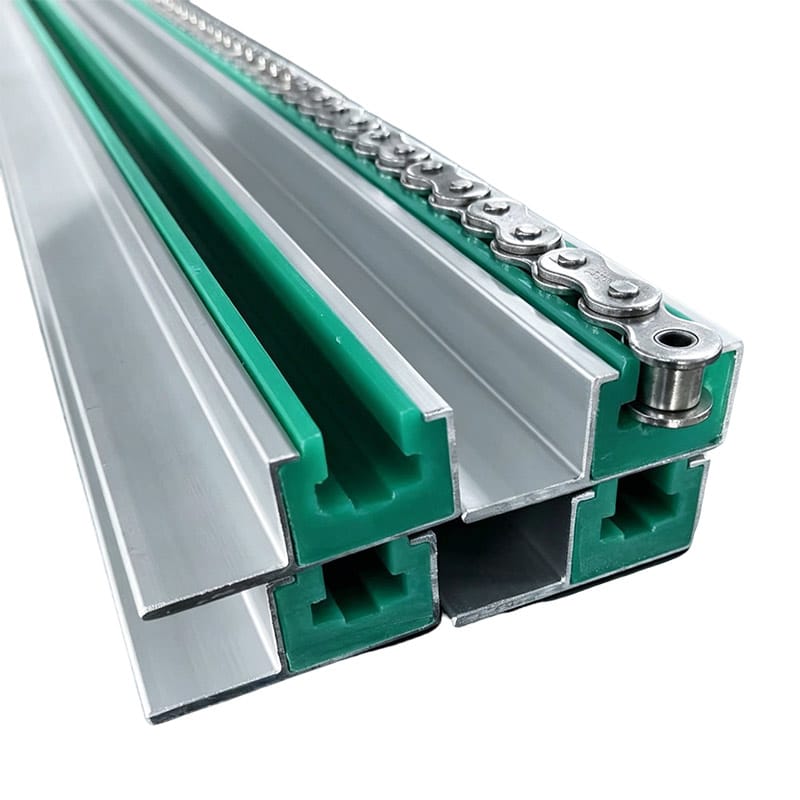
- Chain guides
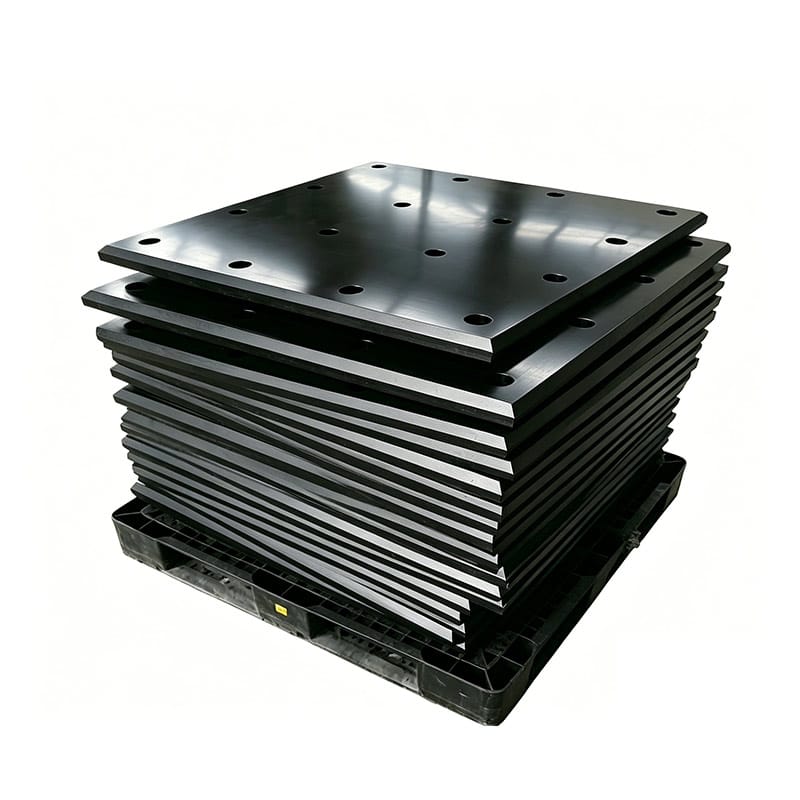
- Chute and hopper liners
- Guide rails
- Sliding plates
- Scraper components
- Wear pads
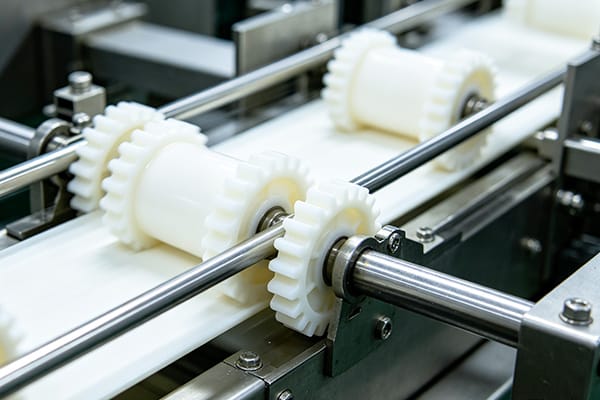
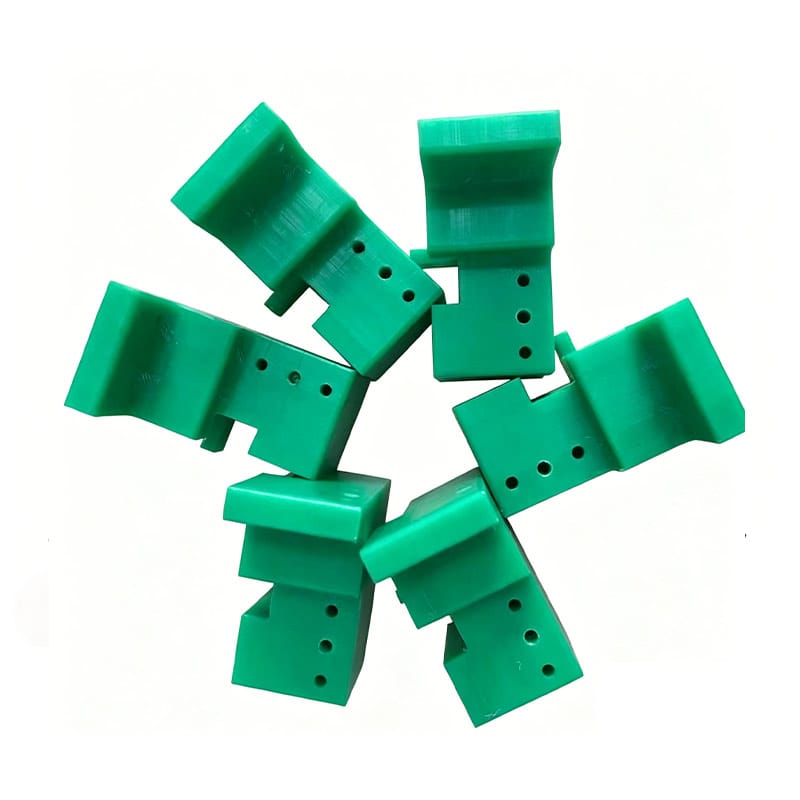
- Custom CNC-machined plastic parts
- Bulk-material handling components
For applications where components repeatedly slide against metal, chain, products, or bulk materials, PE1000 is often considered because of its combination of wear resistance, impact toughness, and low-friction characteristics.
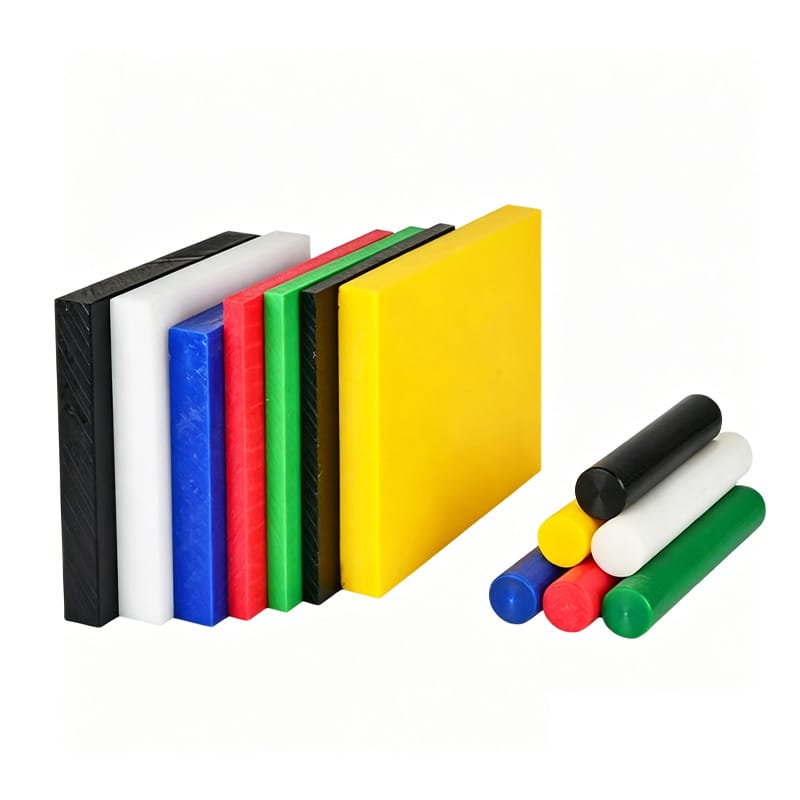
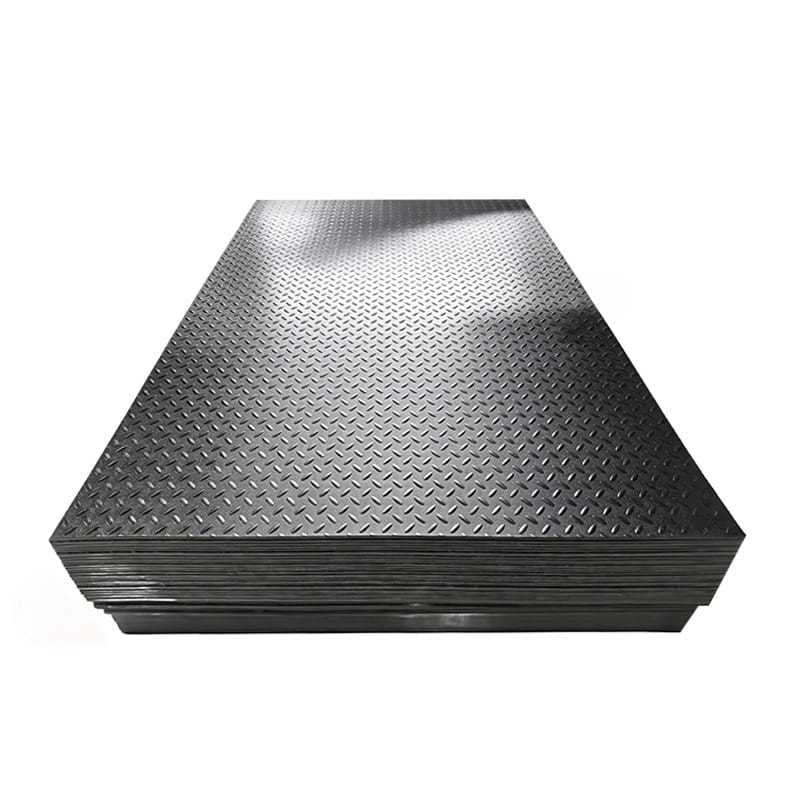
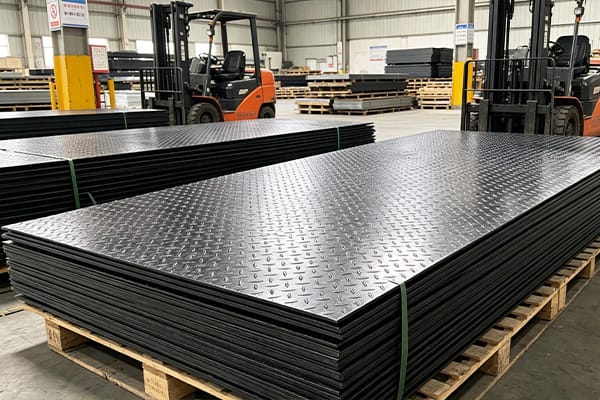
Paowo Group supplies UHMWPE engineering plastic sheets for industrial applications and can also machine material into application-specific components.
What Is PE500?
PE500 is generally classified as a high-molecular-weight polyethylene grade positioned below PE1000 in molecular-weight class.
It still offers many characteristics associated with polyethylene, including good chemical resistance, toughness, and relatively low moisture absorption.
PE500 may be considered for:
- General engineering components
- Cutting surfaces
- Wear plates
- Guides
- Spacers
- Support components
- Food-processing components where the specific material grade is suitable
- Machined parts exposed to moderate mechanical wear
The important point is that PE500 is not simply an inferior version of PE1000. In some applications, its balance of properties, machinability, availability, and cost may make it the more appropriate engineering choice.
PE1000 vs PE500: Key Differences at a Glance
The practical differences between PE1000 and PE500 become clearer when they are compared according to the requirements of the application rather than by material name alone.
| Selection Factor | PE1000 | PE500 |
|---|---|---|
| Material family | UHMWPE | High-molecular-weight polyethylene |
| Wear-focused applications | Very commonly selected | Suitable for moderate-duty applications |
| Sliding applications | Strong candidate | Suitable depending on conditions |
| Impact resistance | Excellent characteristic of UHMWPE | Good toughness |
| Low-friction applications | Frequently preferred | Can perform well |
| Machined industrial parts | Widely used | Widely used |
| Heavy abrasion | Often preferred | Application dependent |
| General engineering use | Suitable | Often practical |
| Cost consideration | Usually requires stronger justification | Can be economical for less demanding duties |
This table should be treated as a selection framework rather than a universal performance ranking. Actual properties vary according to resin grade, manufacturer, additives, processing method, temperature, testing standard, and other factors.
When exact performance matters, buyers should compare supplier technical data sheets under equivalent test conditions.
How Does Molecular Weight Affect PE1000 vs PE500 Performance?
Molecular weight is one of the fundamental differences behind the behavior of these materials.
Polyethylene consists of long molecular chains. As molecular weight increases, chain behavior changes, influencing properties such as wear resistance, toughness, melt behavior, and processing characteristics.
PE1000’s ultra-high molecular weight is one reason it behaves differently from conventional polyethylene grades.
Why Higher Molecular Weight Can Matter in Wear Applications
Wear does not depend on molecular weight alone. Surface pressure, counterface material, contamination, temperature, speed, lubrication, geometry, and alignment can all influence component life.
However, the molecular structure of UHMWPE is one reason PE1000 is widely used for applications involving:
- Repeated sliding
- Abrasive contact
- Chain movement
- Product guidance
- Bulk-material flow
- Impact combined with wear
For a procurement team, this means the material should be selected according to the wear system, not merely according to a material specification written on an old drawing.
PE1000 vs PE500 Wear Resistance
Wear resistance is often the main reason buyers begin comparing PE1000 vs PE500.
If the application involves continuous sliding, abrasive particles, chain contact, or bulk solids, wear performance can directly affect maintenance intervals and equipment downtime.
When PE1000 Is Usually Considered
PE1000 is commonly evaluated for high-wear components such as conveyor guides and wear liners.
For example, a chain guide can experience continuous sliding contact for thousands of operating hours. A chute liner may face repeated contact with abrasive material while also receiving impact at transfer points.
In these situations, the material must do more than simply support a static load.
It must maintain a useful surface while interacting with another moving material.
That is why PE1000 frequently appears in:
- Conveyor systems
- Packaging lines
- Material-handling equipment
- Mining equipment
- Aggregate handling
- Food-processing machinery
- Bottling and filling lines
- Industrial automation
Paowo Group also manufactures UHMWPE wear liners for applications where material flow and surface wear are important design considerations.
When PE500 May Be Enough
Not every wear component operates under severe abrasion.
A PE500 component may be entirely appropriate when:
- Sliding speed is moderate
- Contact pressure is limited
- Abrasive contamination is low
- Replacement is easy
- Wear life is not the dominant operating cost
- The component mainly serves as a support or guide
- The equipment operates intermittently
Specifying PE1000 automatically can therefore result in paying for performance that the application does not actually require.
The better approach is to determine the wear conditions first.
PE1000 vs PE500 for Impact and Toughness
Industrial wear components rarely experience perfectly controlled loading.
Material can drop into a hopper. A conveyor can jam. A guide can receive intermittent side loading. Heavy particles can strike a liner. Installation tolerances can introduce unexpected stress.
Impact behavior therefore matters.
Why PE1000 Is Popular in Impact-Prone Environments
UHMWPE is well known for its toughness, which is one reason PE1000 is frequently selected for industrial components exposed to a combination of wear and impact.
This can be useful for:
- Chute liners
- Hopper liners
- Conveyor components
- Loading areas
- Material transfer systems
- Impact-facing wear components
However, an important engineering distinction must be made.
Impact resistance does not mean unlimited structural capacity.
A PE1000 sheet should not automatically be treated as a structural plate simply because the material is tough. Thickness, unsupported span, fastening arrangement, temperature, creep, load duration, and deformation limits must still be considered.
Which Material Has Better Stiffness?
Wear resistance is only one part of material selection.
In some applications, stiffness and dimensional control can matter more than maximum abrasion resistance.
A guide or machined component may need to maintain a particular position relative to another component. If excessive deformation changes that relationship, the theoretically more wear-resistant material may not produce the better assembly.
Why Stiffness Changes the Selection
Consider a long guide rail.
The design may require the rail to:
- Remain aligned
- Support side loading
- Maintain clearance
- Prevent chain movement
- Hold a defined profile
- Remain stable between mounting points
The designer therefore needs to evaluate not only wear resistance but also:
- Section geometry
- Support spacing
- Fastening method
- Operating temperature
- Thermal expansion
- Continuous loading
- Permitted deflection
This is particularly important when replacing a metal component with polyethylene.
A plastic part should not be designed by simply copying the dimensions of a metal part without reconsidering the material behavior.
PE1000 vs PE500 Friction and Sliding Applications
Low-friction behavior is another reason polyethylene materials are used in conveyor and material-handling equipment.
PE1000 is particularly common in sliding components such as UHMWPE chain guides.
Applications Where Sliding Performance Matters
Typical examples include:
- Roller-chain guides
- Conveyor wear strips
- Product guide rails
- Bottle conveyor components
- Sliding support strips
- Packaging machinery
- Food-processing conveyors
- Transfer equipment
But material selection alone cannot solve every friction problem.
If a chain guide is overheating or wearing unevenly, the cause may instead involve:
- Incorrect alignment
- Excessive chain tension
- Poor chain condition
- Contamination
- Insufficient clearance
- Incorrect guide profile
- Excessive operating speed
- Poor support spacing
Changing PE500 to PE1000 without correcting the mechanical problem may simply delay the same failure.
How Temperature Changes the PE1000 vs PE500 Decision
Temperature is sometimes overlooked when polyethylene components are specified.
Plastic components can respond to temperature changes differently from surrounding steel frames, shafts, fasteners, and conveyor structures.
Thermal Expansion Must Be Included in the Design
A long polyethylene guide rail can change length as temperature changes.
If both ends are rigidly constrained without sufficient allowance for thermal movement, stresses or deformation may develop.
For long components, designers should consider:
- Installation temperature
- Minimum operating temperature
- Maximum operating temperature
- Total component length
- Fixed and floating mounting points
- Slot dimensions
- Joint spacing
- Clearance with adjacent components
The correct design should be based on the actual material data for the supplied grade.
Do not assume PE1000 and PE500 will behave identically simply because both are polyethylene.
PE1000 vs PE500 Machinability
Both materials can be machined into custom industrial components, but machining polyethylene requires an understanding of plastic behavior.
The material is not machined exactly like steel or aluminum.
Common Machining Operations
PE1000 and PE500 parts may require:
- CNC milling
- Routing
- Drilling
- Turning
- Grooving
- Profiling
- Countersinking
- Pocket machining
- Cutting
- Edge finishing
Paowo Group provides custom UHMWPE machined parts based on drawings, samples, or application requirements.
Why Tolerance Should Be Discussed Before Ordering
A drawing created for a metal component may contain tolerances that are unnecessarily tight for a polyethylene replacement.
This can increase machining complexity without improving equipment performance.
Before specifying tolerances, determine:
- Which dimensions affect assembly
- Which dimensions control alignment
- Which surfaces are functional
- Which holes locate the component
- Which dimensions can use general tolerances
- What temperature the component will experience
- How the part will be inspected
For custom plastic parts, functional tolerancing is usually more useful than applying tight tolerances to every dimension.
Which Material Is Better for Chute and Hopper Liners?
For chute and hopper applications, material selection should begin with the bulk material and flow conditions.
PE1000 is frequently considered because the application may combine abrasion, sliding, sticking, impact, and corrosion exposure.
Important Inputs for Liner Selection
Before selecting PE1000 or PE500, collect information about:
- Bulk material
- Particle size
- Particle shape
- Moisture content
- Material temperature
- Drop height
- Flow speed
- Impact zone
- Existing liner material
- Existing failure mode
- Required liner thickness
- Fastening method
A quarry chute handling angular aggregate creates a very different wear environment from a hopper handling fine powder.
The words “wear liner” therefore do not provide enough information to select a grade.
For more application-specific information, see Paowo Group’s mining and bulk material handling solutions.
Which Material Is Better for Conveyor Chain Guides?
Chain guides create another common PE1000 vs PE500 decision.
Here, the interaction between the chain and guide is often more important than the material specification alone.
Check the Chain Before Selecting the Guide Material
Useful information includes:
- Chain type
- Chain size
- Chain width
- Guide profile
- Conveyor speed
- Operating temperature
- Chain tension
- Lubrication condition
- Mounting arrangement
- Support spacing
- Curved or straight path
- Existing wear pattern
A worn chain can rapidly damage a new guide.
Likewise, poor alignment can produce one-sided wear regardless of whether PE500 or PE1000 is installed.
Material selection should therefore be part of a wider conveyor-system review.
Paowo Group’s conveyor system components section provides additional information for industrial guide and wear applications.
PE1000 vs PE500 Cost: Is PE1000 Always Worth Paying More For?
Procurement decisions often become difficult when one grade appears technically superior but carries a higher material or processing cost.
The correct comparison should be based on total application cost, not sheet price alone.
Consider Total Cost of Ownership
A lower-cost material may become expensive if it causes:
- Frequent replacement
- Additional maintenance
- Conveyor downtime
- Product contamination
- Emergency spare-part purchases
- Increased labor requirements
On the other hand, using a premium wear material for a lightly loaded, easily replaceable component may provide little financial benefit.
A useful purchasing question is:
What does failure of this component actually cost the operation?
If the part is difficult to access and equipment downtime is expensive, extending maintenance intervals may justify a higher material cost.
If the part is non-critical and simple to replace, PE500 may be perfectly adequate.
How to Choose Between PE1000 and PE500
Instead of asking suppliers only for a price per sheet, provide enough application information for a meaningful comparison.
Choose PE1000 When the Application Prioritizes Wear and Sliding Performance
PE1000 is commonly considered when:
- Abrasion is a major failure mechanism
- Continuous sliding occurs
- Low-friction movement is important
- Impact and wear occur together
- Maintenance access is difficult
- Longer service intervals are valuable
- The component is a conveyor wear strip or chain guide
- The component is a chute or hopper liner
Consider PE500 When the Application Is Less Wear Intensive
PE500 may be appropriate when:
- Wear conditions are moderate
- The component is used intermittently
- Structural geometry is more important than maximum wear performance
- Replacement is straightforward
- Cost is a significant design constraint
- The component performs a general engineering function
- Historical service data already shows acceptable PE500 performance
The final selection should still be checked against the technical data for the exact material grade being purchased.
What Information Should You Send a Supplier?
A supplier can make a much more useful recommendation when the inquiry contains actual application data.
For sheet material, provide:
- Required grade
- Sheet length and width
- Thickness
- Quantity
- Color
- Required documentation
- Final application
For a machined component, also provide:
- 2D drawing
- STEP or other 3D model where available
- Critical tolerances
- Hole positions
- Surface requirements
- Quantity per order
- Annual demand
- Inspection requirements
For wear applications, add:
- Counterface material
- Sliding speed
- Load
- Operating temperature
- Abrasive material
- Existing wear pattern
- Current material
- Current service life
These inputs help determine whether PE1000, PE500, or another engineering plastic should be evaluated.
Common Mistakes When Comparing PE1000 vs PE500
Several purchasing mistakes repeatedly make polyethylene selection more difficult than necessary.
Choosing Only by Material Price
Sheet price does not account for machining, maintenance, downtime, or replacement frequency.
Assuming Higher Grade Always Means Better
A technically more wear-resistant material is not automatically the best material for every component.
Ignoring the Existing Failure Mode
If the current component fails because of misalignment, poor mounting, or excessive temperature, changing the polyethylene grade may not solve the problem.
Copying a Metal Drawing Directly into Plastic
Plastic components may require different thicknesses, support spacing, clearances, mounting slots, and tolerances.
Comparing Data from Different Test Methods
Property values should only be compared when test conditions and standards are reasonably equivalent.
For standardized plastics terminology and testing references, engineers can consult resources from ISO and ASTM International and then verify which specific standards are referenced by the material supplier.
FAQ
Is PE1000 the Same as UHMWPE?
PE1000 is commonly used commercially to describe a UHMWPE material class. However, procurement specifications should identify the actual supplied grade and supporting technical documentation rather than relying only on the PE1000 name.
Is PE500 Also UHMWPE?
PE500 is generally categorized as high-molecular-weight polyethylene rather than the PE1000 UHMWPE class. Exact classifications and material properties should be confirmed with the supplier.
Is PE1000 More Wear Resistant Than PE500?
PE1000 is widely selected for demanding abrasion and sliding applications. However, exact wear performance depends on the specific grade and test conditions as well as the actual operating environment.
Can PE500 Replace PE1000?
Sometimes, but not automatically. If the application has moderate wear requirements and historical performance supports the change, PE500 may be considered. For severe abrasion or critical sliding components, changing the grade should be evaluated carefully.
Can PE1000 Replace PE500?
In many geometries it may be technically possible, but there may be no economic benefit. Dimensional behavior, stiffness requirements, machining tolerances, and operating conditions should also be reviewed.
Which Material Is Better for Conveyor Guides?
PE1000 is commonly used for conveyor wear strips and chain guides because sliding and wear performance are often priorities. The chain condition, speed, load, alignment, temperature, and guide geometry should still be evaluated.
Which Material Is Better for Chute Liners?
PE1000 is frequently considered for wear and flow applications, but the correct liner depends on the handled material, particle characteristics, impact, moisture, temperature, geometry, and existing failure mechanism.
Can PE1000 and PE500 Be CNC Machined?
Yes. Both materials can be machined into custom components. Appropriate machining parameters, tolerance design, fixturing, and inspection methods should be used for engineering plastics.
Conclusion
The PE1000 vs PE500 decision should not be reduced to “which material is better?”
The better question is which polyethylene grade provides the right combination of wear resistance, toughness, dimensional behavior, machinability, friction performance, and cost for the specific operating conditions?
PE1000 is a strong candidate when abrasion, sliding, impact, and maintenance life are important. PE500 can be a practical engineering material for less demanding wear conditions and general industrial components where the additional characteristics of UHMWPE are not required.
For industrial buyers, the most reliable selection process starts with application data: load, speed, temperature, wear mechanism, geometry, mating material, installation method, and expected service conditions.
Paowo Group supplies UHMWPE engineering plastic sheets and custom UHMWPE machined parts for industrial applications. Send your dimensions, drawings, operating conditions, and current material information for an application-based material comparison and quotation.