Table of Contents
A conveyor chain enters a curved section after a straight run. For buyers reviewing curved chain guides, the practical question is whether the offered product and its supporting evidence address this specific requirement.
This guide examines radius transitions and tangent continuity as a defined engineering and purchasing decision. It connects the duty, interface, qualification and quotation so procurement can resolve the important questions before releasing an order.

Radius Transitions and Tangent Continuity
An abrupt transition can create side contact or a local step even when both segments fit individually.
Draw the straight and curved centerlines together and mark their tangent points on the supporting structure. Check the installed entry and exit, not just the machined radius. During the authorized trial, locate any repeated side mark relative to those transitions. If the problem occurs at one tangent, investigate the interface before replacing the entire curved profile with a different material.
Start by separating the observed symptom from the proposed product change. Record what happens, where it happens and the operating condition in which it matters. That makes the review of curved chain guides specific enough to support a decision, rather than a comparison of broad product descriptions.
Metal support
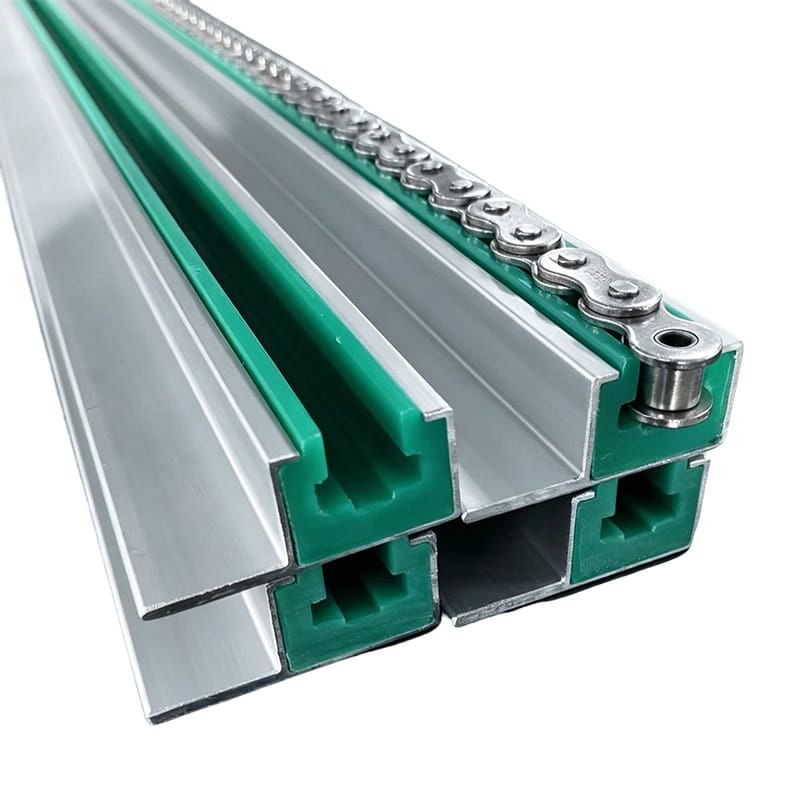
The backing channel or brackets used with curved chain guides are part of the assembly. Their dimensions and alignment influence the installed plastic profile. Check that retention does not pinch or distort the working face and that the approved movement is possible. Request both sides of the interface rather than treating the plastic section as an isolated product.
The inputs that define curved chain guides
Record centerline radius, chain articulation, tangent locations, mounting datums. Keep the units, revision and source of each input with the inquiry. Distinguish a measured value from an estimate, and identify the person responsible for resolving any critical unknown. A supplier can review an explicit assumption; an undocumented assumption is much harder to detect.
Curved runs
A curved section of curved chain guides needs coordination with chain articulation and adjoining straight runs. Review radius, tangent continuity and the actual mounting datums. A correct radius on the plastic part is insufficient when the support structure creates an entry step. Inspect the complete assembled path and use a controlled operating trial within the equipment’s approved procedures.
Design the complete interface: curved chain guides
Coordinate the complete transition with the chain manufacturer’s permitted geometry.
Review curved chain guides in the installed arrangement. Show adjoining components, the direction of movement or load, and the space needed for installation and later removal. If the interface changes, update the released drawing and acceptance basis together so the quote and the technical approval still refer to the same requirement.
Friction system
Low friction in curved chain guides depends on the contact pair, alignment, load and contamination. Follow the chain manufacturer’s lubrication requirements; the polymer description does not make the entire chain system lubrication-free. Inspect counterfaces and debris when wear or heating appears. Material substitution should follow an investigation of the full contact system.
Compare the available procurement routes
Use the comparison below to decide what must happen before purchasing curved chain guides. The routes describe different scopes of work; they are not interchangeable offers. In this application, the controlling issue is radius transitions and tangent continuity. An apparently cheaper route may leave that issue unresolved.
| Route | When it merits review | Evidence needed before release |
|---|---|---|
| Standard profile | Potentially suitable where chain and mounting interfaces match. | Verify functional section dimensions and the full supported path. |
| Custom profile | Useful where a reviewed groove, curve or interface is required. | Approve the section drawing, mating support and representative fit. |
| System adjustment | Needed where alignment, contamination or adjoining equipment dominates. | Correct the operating system instead of only changing the plastic profile. |
Machined surfaces
The functional faces of curved chain guides need appropriate machining and edge treatment. Small burrs at slots or profile ends can disturb the chain even when the broad sliding surface looks smooth. Identify critical areas on the drawing and inspect the complete path. Deburring should remove defects while preserving the approved profile geometry.
Qualify a representative sample or trial: curved chain guides
Check the assembled path and perform an authorized controlled running trial.
For curved chain guides, write the trial objective before collecting results. Record the item or sample identity, drawing revision, conditions, observations and acceptance decision. Keep a photograph or measurement record where it helps explain the outcome. If the trial covers only one part of the duty, retain the remaining questions instead of treating a limited result as full approval.
Worn samples
A worn sample of curved chain guides is evidence of service, not necessarily a reliable nominal drawing. Groove width, contact height and edges may have changed. Use unworn datums, mating channels and chain information to reconstruct intended geometry with the equipment owner. Approve a drawing and first article before reproducing the sample at production quantity.

Recognize the limits and stop conditions
A repeated mark at the entry or exit indicates a transition or alignment issue.
Define who can suspend approval and who can authorize a correction. Preserve the failed item, relevant measurements and operating details where practical. Changing the product and the surrounding process simultaneously can make the cause difficult to establish. The next action should resolve the controlling uncertainty rather than merely repeat the purchase with a larger nominal size.
Alignment
When checking curved chain guides, inspect the supporting structure over the complete operating length. Small bracket-height differences or a twisted channel can create recurring contact peaks. Verify the reference line and functional mounting planes before blaming the plastic material. Compare wear tracks with support positions and chain condition to focus the investigation.
Build a complete quotation package
Provide the full curve and adjoining straight geometry rather than a radius alone.
The quotation package for curved chain guides should identify the requested quantity, delivery destination and purchased condition, together with the relevant drawing or layout. Ask suppliers to list exclusions and deviations clearly. Compare like scope: material identity, functional dimensions, inspection, packing and any first-article work should be visible beside the unit price.
First article
A first article of curved chain guides should demonstrate the critical section, mating support and intended chain fit. Agree the measurement condition and retain a reference if recurring supply is planned. Use an approved assembly trial where necessary. Cosmetic approval alone should not release a profile whose functional groove or mounting details remain unverified.
Identification
Identify curved chain guides by drawing, profile and compatible conveyor station rather than color alone. Several sections may look alike while carrying different grooves or support details. Label stored spares and retain the chain reference. A clear station-to-part register reduces the chance of installing a convenient but incompatible profile during an urgent repair.
Discuss the reviewed requirement with Paowo
Paowo lists UHMWPE Chain Guides among its current products and describes drawing- and sample-based work through its OEM and ODM custom service. For the application discussed here, send the specific interface and duty information before asking for a final recommendation.
You can also review the site’s related application area and the existing article UHMWPE Chain Guides for Bottling and Packaging Conveyors for adjoining considerations. Keep the scope of this inquiry centered on radius transitions and tangent continuity.
For authoritative context, see HSE conveyor and machinery guarding guidance. HSE guarding guidance reinforces the need to prevent access to hazardous moving parts and control maintenance work. It supports the maintenance context here; it does not endorse a guide profile or predict friction and wear.
Request a review of curved chain guides with your drawings, operating conditions, required outcome and delivery needs. Ask Paowo to identify the offered grade and specification, state unresolved assumptions and separate sample work from production scope. Use the inquiry form after the FAQ to share the requirement and request a quotation.
Frequently Asked Questions
What is the first issue to review for curved chain guides?
An abrupt transition can create side contact or a local step even when both segments fit individually. Start with the actual duty and the relevant interfaces rather than the product name alone.
What information is needed to specify curved chain guides?
Provide centerline radius, chain articulation, tangent locations, mounting datums. Include a drawing or layout showing the complete interface and identify critical unknowns before release.
How should a trial of curved chain guides be assessed?
Check the assembled path and perform an authorized controlled running trial. Keep sample identity, representative conditions and the agreed acceptance decision in the trial record.
When should approval of curved chain guides be held?
A repeated mark at the entry or exit indicates a transition or alignment issue. Resolve the cause and obtain the responsible technical approval before release or continued use.
What should I send Paowo when requesting curved chain guides?
Provide the full curve and adjoining straight geometry rather than a radius alone. Add the quantity, destination, current drawing revision and required documentation so offers can be compared on equivalent scope.